1.2 Slope of a Line
- Find the slope of a line using two points.
- Graph a line when you know one point and the slope.
In the last section, we graphed lines by finding two points. But there's a faster way: if you know just one point and how "steep" the line is, you can draw it immediately. That "steepness" number is called the slope of the line.
Context Pause
Why does slope matter in the real world? Architects use slope to design roofs that drain properly (usually a 4:12 pitch). Highway engineers use it to calculate safe grades for roads (typically 6% or less). In business, slope represents your rate of change—like how much profit increases for each additional product sold. Understanding slope gives you a way to measure change and predict trends.
You might remember slope from earlier courses as "rise over run"—the vertical change divided by the horizontal change. You may have seen it written as:
\[ \frac{\text{rise}}{\text{run}}, \quad \frac{\text{vertical change}}{\text{horizontal change}}, \quad \frac{\Delta y}{\Delta x} \]Now let's make this precise with a formal definition.
Source: Main Text
If \((x_1, y_1)\) and \((x_2, y_2)\) are two different points on a line, the slope of the line is:
\[ m = \frac{y_2 - y_1}{x_2 - x_1} \]We use the letter \(m\) to represent slope. Think of the formula as "the change in \(y\) divided by the change in \(x\)."
Source: Main Text
Problem Statement:
Find the slope of the line passing through points \((-2, 3)\) and \((4, -1)\), and graph the line.
Solution:
Let \((x_1, y_1) = (-2, 3)\) and \((x_2, y_2) = (4, -1)\). Plug these into the slope formula:
\[ m = \frac{-1 - 3}{4 - (-2)} = \frac{-4}{6} = -\frac{2}{3} \]So the slope is \(-\frac{2}{3}\).
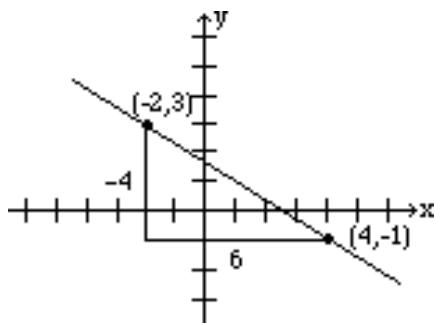
In the figure above, we show the vertical change of \(-4\) (down 4 units) and the horizontal change of \(6\) (right 6 units) to help you visualize what the slope number means.
Insight Note
It doesn't matter which point you call "point 1" and which you call "point 2." If you swap them, you get the same answer! Let's check: If we use \((x_1, y_1) = (4, -1)\) and \((x_2, y_2) = (-2, 3)\), then: \[ m = \frac{3 - (-1)}{-2 - 4} = \frac{4}{-6} = -\frac{2}{3} \] Same result! The negative sign simply tells us the line falls as we move from left to right.
Notice the pattern:
- If a line rises from left to right, it has a positive slope (as \(x\) increases, \(y\) increases).
- If a line falls from left to right, it has a negative slope (as \(x\) increases, \(y\) decreases).
Source: Main Text
Problem Statement:
Find the slope of the line that passes through the points \((2, 3)\) and \((2, -1)\), and graph.
Solution:
Let \((x_1, y_1) = (2, 3)\) and \((x_2, y_2) = (2, -1)\). Applying the formula:
\[ m = \frac{-1 - 3}{2 - 2} = \frac{-4}{0} = \text{undefined} \]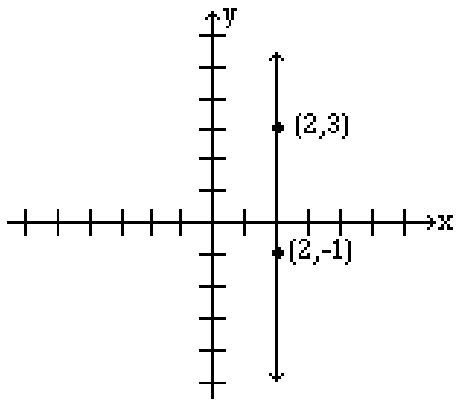
Note: The slope of a vertical line is undefined because we cannot divide by zero. This makes sense—a vertical line is infinitely steep!
Source: Main Text
Problem Statement:
Find the slope of the line that passes through the points \((-1, -4)\) and \((3, -4)\).
Solution:
Let \((x_1, y_1) = (-1, -4)\) and \((x_2, y_2) = (3, -4)\). Applying the formula:
\[ m = \frac{-4 - (-4)}{3 - (-1)} = \frac{0}{4} = 0 \]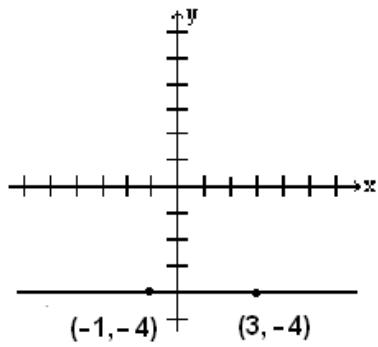
Note: The slope of a horizontal line is 0. This makes sense too—there is zero steepness; the line is perfectly flat.
Source: Main Text
Problem Statement:
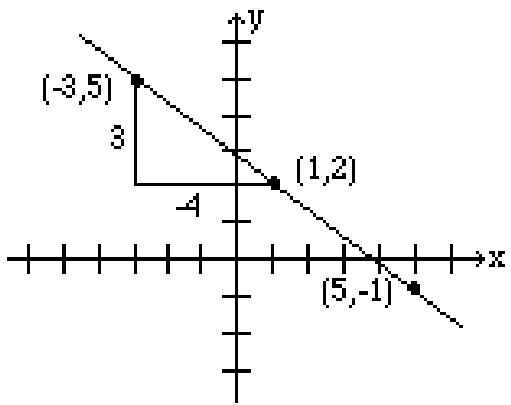
Graph the line that passes through the point \((1, 2)\) and has slope \(-\frac{3}{4}\).
Solution:
Slope equals \(\frac{\text{rise}}{\text{run}}\). A slope of \(-\frac{3}{4}\) means for every rise of \(-3\) units (a fall of 3 units), there is a run of \(4\) units to the right.
Starting at \((1, 2)\):
- Go down 3 units (to \(y = -1\))
- Go right 4 units (to \(x = 5\))
This brings us to the point \((5, -1)\). Connect \((1, 2)\) and \((5, -1)\) to graph the line.
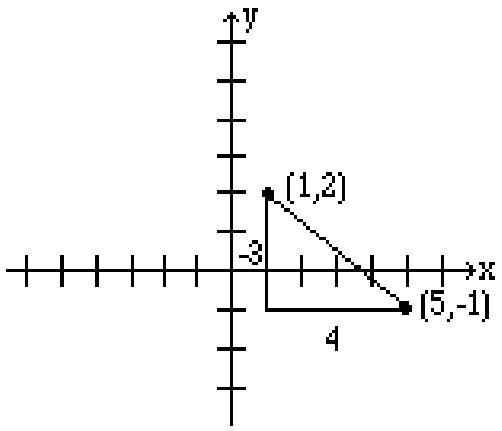
Alternatively, remember that \(\frac{-3}{4} = \frac{3}{-4}\). So we could also:
- Go up 3 units from \((1, 2)\) to \((1, 5)\)
- Go left 4 units to \((-3, 5)\)
Both methods give us two points on the same line:
Source: Main Text
Problem Statement:
Find the slope of the line \(2x + 3y = 6\).
Solution:
To find the slope, we need two points on the line. The x-intercept and y-intercept are usually the easiest to find.
- For the x-intercept, set \(y = 0\): \(2x = 6\), so \(x = 3\). Point: \((3, 0)\)
- For the y-intercept, set \(x = 0\): \(3y = 6\), so \(y = 2\). Point: \((0, 2)\)
Now use the slope formula:
\[ m = \frac{2 - 0}{0 - 3} = \frac{2}{-3} = -\frac{2}{3} \]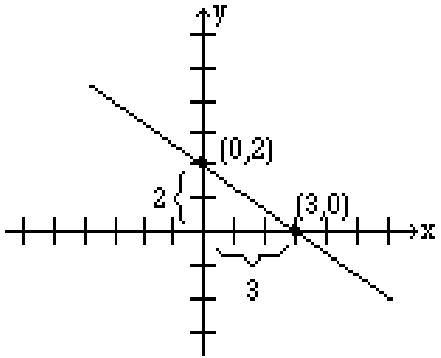
Source: Main Text
Problem Statement:
Find the slope of the line \(y = 3x + 2\).
Solution:
Pick any two points on the line. Easy choices are:
- When \(x = 0\), \(y = 2\): point \((0, 2)\)
- When \(x = 1\), \(y = 5\): point \((1, 5)\)
Calculate the slope:
\[ m = \frac{5 - 2}{1 - 0} = \frac{3}{1} = 3 \]Look at the pattern when the equation is solved for \(y\):
| Equation | Slope (\(m\)) | y-intercept (\(b\)) |
|----------|-------------|-------------------|
| \(y = 3x + 2\) | \(3\) | \(2\) |
| \(y = -2x + 5\) | \(-2\) | \(5\) |
| \(y = \frac{3}{2}x - 4\) | \(\frac{3}{2}\) | \(-4\) |
Notice something? When the equation is in the form \(y = mx + b\), the coefficient of \(x\) is the slope, and the constant term is the y-intercept.
Insight Note
The equation \(y = mx + b\) is like a "fast pass" for graphing. The \(m\) tells you exactly how steep the line is and which way it tilts, while \(b\) tells you where to start on the y-axis. No calculations needed—just read the numbers directly!
Source: Main Text
Problem Statement:
Determine the slope and y-intercept of the line \(2x + 3y = 6\).
Solution:
We need to rewrite the equation in slope-intercept form (\(y = mx + b\)) by solving for \(y\):
\[\begin{align*} 2x + 3y &= 6 \\ 3y &= -2x + 6 \\ y &= -\frac{2}{3}x + 2 \end{align*}\]Now we can read the values directly:
- The slope \(m = -\frac{2}{3}\) (the coefficient of \(x\))
- The y-intercept \(b = 2\) (the constant term)
This confirms what we found in Example 1.2.5 using the two-point method!
Problem Set 1.2
Source: Main Text
Part A: Find the slope between two points
Find the slope of the line passing through the following pairs of points.
1. \((2, 3)\) and \((5, 9)\)
Problem 1 Solution
Step 1: Identify the two points and label them.
Let \((x_1, y_1) = (2, 3)\) and \((x_2, y_2) = (5, 9)\).
Step 2: Apply the slope formula.
\[m = \frac{y_2 - y_1}{x_2 - x_1} = \frac{9 - 3}{5 - 2} = \frac{6}{3} = 2\]Answer: \(m = 2\)
The slope is positive, which means the line rises from left to right.
*Verification:* Moving from \((2, 3)\) to \((5, 9)\): we go right 3 units and up 6 units, giving \(\frac{6}{3} = 2\). ✓
2. \((4, 1)\) and \((2, 5)\)
Problem 2 Solution
Step 1: Identify the two points and label them.
Let \((x_1, y_1) = (4, 1)\) and \((x_2, y_2) = (2, 5)\).
Step 2: Apply the slope formula.
\[m = \frac{y_2 - y_1}{x_2 - x_1} = \frac{5 - 1}{2 - 4} = \frac{4}{-2} = -2\]Answer: \(m = -2\)
The slope is negative, which means the line falls from left to right.
*Verification:* Moving from \((2, 5)\) to \((4, 1)\): we go right 2 units and down 4 units, giving \(\frac{-4}{2} = -2\). ✓
3. \((-1, 1)\) and \((1, 3)\)
Problem 3 Solution
Step 1: Identify the two points and label them.
Let \((x_1, y_1) = (-1, 1)\) and \((x_2, y_2) = (1, 3)\).
Step 2: Apply the slope formula.
\[m = \frac{y_2 - y_1}{x_2 - x_1} = \frac{3 - 1}{1 - (-1)} = \frac{2}{1 + 1} = \frac{2}{2} = 1\]Answer: \(m = 1\)
A slope of 1 means the line rises at a 45° angle — for every 1 unit right, it goes 1 unit up.
*Verification:* Moving from \((-1, 1)\) to \((1, 3)\): we go right 2 units and up 2 units, giving \(\frac{2}{2} = 1\). ✓
4. \((4, 3)\) and \((-1, 3)\)
Problem 4 Solution
Step 1: Identify the two points and label them.
Let \((x_1, y_1) = (4, 3)\) and \((x_2, y_2) = (-1, 3)\).
Step 2: Apply the slope formula.
\[m = \frac{y_2 - y_1}{x_2 - x_1} = \frac{3 - 3}{-1 - 4} = \frac{0}{-5} = 0\]Answer: \(m = 0\) (horizontal line)
Both points have the same \(y\)-coordinate (\(y = 3\)), so the line is horizontal and has zero slope.
*Verification:* A horizontal line through \(y = 3\) passes through both \((4, 3)\) and \((-1, 3)\), with no vertical change. ✓
5. \((6, -5)\) and \((4, -1)\)
Problem 5 Solution
Step 1: Identify the two points and label them.
Let \((x_1, y_1) = (6, -5)\) and \((x_2, y_2) = (4, -1)\).
Step 2: Apply the slope formula.
\[m = \frac{y_2 - y_1}{x_2 - x_1} = \frac{-1 - (-5)}{4 - 6} = \frac{-1 + 5}{-2} = \frac{4}{-2} = -2\]Answer: \(m = -2\)
*Verification:* Moving from \((4, -1)\) to \((6, -5)\): we go right 2 units and down 4 units, giving \(\frac{-4}{2} = -2\). ✓
6. \((5, 3)\) and \((-1, -4)\)
Problem 6 Solution
Step 1: Identify the two points and label them.
Let \((x_1, y_1) = (5, 3)\) and \((x_2, y_2) = (-1, -4)\).
Step 2: Apply the slope formula.
\[m = \frac{y_2 - y_1}{x_2 - x_1} = \frac{-4 - 3}{-1 - 5} = \frac{-7}{-6} = \frac{7}{6}\]Answer: \(m = \dfrac{7}{6}\)
A negative divided by a negative gives a positive slope, so the line rises from left to right.
*Verification:* Moving from \((-1, -4)\) to \((5, 3)\): we go right 6 units and up 7 units, giving \(\frac{7}{6}\). ✓
7. \((3, 4)\) and \((3, 7)\)
Problem 7 Solution
Step 1: Identify the two points and label them.
Let \((x_1, y_1) = (3, 4)\) and \((x_2, y_2) = (3, 7)\).
Step 2: Apply the slope formula.
\[m = \frac{y_2 - y_1}{x_2 - x_1} = \frac{7 - 4}{3 - 3} = \frac{3}{0} = \text{undefined}\]Answer: The slope is undefined (vertical line).
Both points have the same \(x\)-coordinate (\(x = 3\)), so this is a vertical line. Division by zero is undefined, which tells us the line is infinitely steep.
*Verification:* The line \(x = 3\) passes through both \((3, 4)\) and \((3, 7)\), confirming a vertical line. ✓
8. \((-2, 4)\) and \((-3, -2)\)
Problem 8 Solution
Step 1: Identify the two points and label them.
Let \((x_1, y_1) = (-2, 4)\) and \((x_2, y_2) = (-3, -2)\).
Step 2: Apply the slope formula.
\[m = \frac{y_2 - y_1}{x_2 - x_1} = \frac{-2 - 4}{-3 - (-2)} = \frac{-6}{-3 + 2} = \frac{-6}{-1} = 6\]Answer: \(m = 6\)
This is a very steep line — for every 1 unit to the right, the line rises 6 units.
*Verification:* Moving from \((-3, -2)\) to \((-2, 4)\): we go right 1 unit and up 6 units, giving \(\frac{6}{1} = 6\). ✓
9. \((-3, -5)\) and \((-1, -7)\)
Problem 9 Solution
Step 1: Identify the two points and label them.
Let \((x_1, y_1) = (-3, -5)\) and \((x_2, y_2) = (-1, -7)\).
Step 2: Apply the slope formula.
\[m = \frac{y_2 - y_1}{x_2 - x_1} = \frac{-7 - (-5)}{-1 - (-3)} = \frac{-7 + 5}{-1 + 3} = \frac{-2}{2} = -1\]Answer: \(m = -1\)
A slope of \(-1\) means the line falls at a 45° angle — for every 1 unit right, it goes 1 unit down.
*Verification:* Moving from \((-3, -5)\) to \((-1, -7)\): we go right 2 units and down 2 units, giving \(\frac{-2}{2} = -1\). ✓
10. \((0, 4)\) and \((3, 0)\)
Problem 10 Solution
Step 1: Identify the two points and label them.
Let \((x_1, y_1) = (0, 4)\) and \((x_2, y_2) = (3, 0)\).
Step 2: Apply the slope formula.
\[m = \frac{y_2 - y_1}{x_2 - x_1} = \frac{0 - 4}{3 - 0} = \frac{-4}{3} = -\frac{4}{3}\]Answer: \(m = -\dfrac{4}{3}\)
*Verification:* Moving from \((0, 4)\) to \((3, 0)\): we go right 3 units and down 4 units, giving \(\frac{-4}{3}\). ✓
Part B: Find the slope from the equation
Determine the slope of the line from the given equation.
11. \(y = -2x + 1\)
Problem 11 Solution
Step 1: Identify the form of the equation.
The equation \(y = -2x + 1\) is already in slope-intercept form \(y = mx + b\).
Step 2: Read the slope directly from the equation.
Comparing \(y = -2x + 1\) with \(y = mx + b\):
- The coefficient of \(x\) is \(-2\), so \(m = -2\)
- The constant term is \(1\), so \(b = 1\) (the \(y\)-intercept)
Answer: \(m = -2\)
*Verification:* Pick two points on the line. When \(x = 0\): \(y = 1\), giving \((0, 1)\). When \(x = 1\): \(y = -1\), giving \((1, -1)\). Slope \(= \frac{-1 - 1}{1 - 0} = \frac{-2}{1} = -2\). ✓
12. \(y = 3x - 2\)
Problem 12 Solution
Step 1: Identify the form of the equation.
The equation \(y = 3x - 2\) is already in slope-intercept form \(y = mx + b\).
Step 2: Read the slope directly from the equation.
Comparing \(y = 3x - 2\) with \(y = mx + b\):
- The coefficient of \(x\) is \(3\), so \(m = 3\)
- The constant term is \(-2\), so \(b = -2\) (the \(y\)-intercept)
Answer: \(m = 3\)
*Verification:* Pick two points on the line. When \(x = 0\): \(y = -2\), giving \((0, -2)\). When \(x = 1\): \(y = 1\), giving \((1, 1)\). Slope \(= \frac{1 - (-2)}{1 - 0} = \frac{3}{1} = 3\). ✓
13. \(2x - y = 6\)
Problem 13 Solution
Step 1: Solve the equation for \(y\) to put it in slope-intercept form.
\[2x - y = 6\]Subtract \(2x\) from both sides:
\[-y = -2x + 6\]Multiply both sides by \(-1\):
\[y = 2x - 6\]Step 2: Read the slope from slope-intercept form \(y = mx + b\).
Comparing \(y = 2x - 6\) with \(y = mx + b\): the coefficient of \(x\) is \(2\).
Answer: \(m = 2\)
*Verification:* Pick two points on \(y = 2x - 6\). When \(x = 0\): \(y = -6\), giving \((0, -6)\). When \(x = 3\): \(y = 0\), giving \((3, 0)\). Slope \(= \frac{0 - (-6)}{3 - 0} = \frac{6}{3} = 2\). ✓
14. \(x + 3y = 6\)
Problem 14 Solution
Step 1: Solve the equation for \(y\) to put it in slope-intercept form.
\[x + 3y = 6\]Subtract \(x\) from both sides:
\[3y = -x + 6\]Divide both sides by \(3\):
\[y = -\frac{1}{3}x + 2\]Step 2: Read the slope from slope-intercept form \(y = mx + b\).
Comparing \(y = -\frac{1}{3}x + 2\) with \(y = mx + b\): the coefficient of \(x\) is \(-\frac{1}{3}\).
Answer: \(m = -\dfrac{1}{3}\)
*Verification:* Pick two points on \(y = -\frac{1}{3}x + 2\). When \(x = 0\): \(y = 2\), giving \((0, 2)\). When \(x = 3\): \(y = -1 + 2 = 1\), giving \((3, 1)\). Slope \(= \frac{1 - 2}{3 - 0} = \frac{-1}{3} = -\frac{1}{3}\). ✓
15. \(3x - 4y = 12\)
Problem 15 Solution
Step 1: Solve the equation for \(y\) to put it in slope-intercept form.
\[3x - 4y = 12\]Subtract \(3x\) from both sides:
\[-4y = -3x + 12\]Divide both sides by \(-4\):
\[y = \frac{-3}{-4}x + \frac{12}{-4} = \frac{3}{4}x - 3\]Step 2: Read the slope from slope-intercept form \(y = mx + b\).
Comparing \(y = \frac{3}{4}x - 3\) with \(y = mx + b\): the coefficient of \(x\) is \(\frac{3}{4}\).
Answer: \(m = \dfrac{3}{4}\)
*Verification:* Pick two points on \(y = \frac{3}{4}x - 3\). When \(x = 0\): \(y = -3\), giving \((0, -3)\). When \(x = 4\): \(y = 3 - 3 = 0\), giving \((4, 0)\). Slope \(= \frac{0 - (-3)}{4 - 0} = \frac{3}{4}\). ✓
16. What is the slope of the x-axis? What is the slope of the y-axis?
Problem 16 Solution
Part (a): Slope of the x-axis
Step 1: Identify the equation of the x-axis.
The x-axis is the horizontal line \(y = 0\).
Step 2: Pick any two points on the x-axis, such as \((0, 0)\) and \((5, 0)\).
\[m = \frac{0 - 0}{5 - 0} = \frac{0}{5} = 0\]Answer: The slope of the x-axis is \(\mathbf{0}\).
Any horizontal line has slope 0 because there is no vertical change.
Part (b): Slope of the y-axis
Step 1: Identify the equation of the y-axis.
The y-axis is the vertical line \(x = 0\).
Step 2: Pick any two points on the y-axis, such as \((0, 0)\) and \((0, 5)\).
\[m = \frac{5 - 0}{0 - 0} = \frac{5}{0} = \text{undefined}\]Answer: The slope of the y-axis is undefined.
Any vertical line has undefined slope because the denominator (change in \(x\)) is zero, and division by zero is undefined.
Part C: Graph using point and slope
Graph the line that passes through the given point and has the given slope.
17. \((1, 2)\) and \(m = -\frac{3}{4}\)
Problem 17 Solution
Step 1: Start at the given point \((1, 2)\).
Step 2: Interpret the slope as \(\dfrac{\text{rise}}{\text{run}}\).
\[m = -\frac{3}{4} = \frac{-3}{4}\]This means: go down 3 units (rise = \(-3\)) and right 4 units (run = \(4\)).
Step 3: Find a second point.
Starting at \((1, 2)\):
- Down 3: \(y = 2 - 3 = -1\)
- Right 4: \(x = 1 + 4 = 5\)
Second point: \((5, -1)\)
Step 4: Find a third point for accuracy (optional, using the equivalent form \(\frac{3}{-4}\)).
Starting at \((1, 2)\):
- Up 3: \(y = 2 + 3 = 5\)
- Left 4: \(x = 1 - 4 = -3\)
Third point: \((-3, 5)\)
Answer: Plot \((1, 2)\), \((5, -1)\), and \((-3, 5)\), then draw a straight line through all three points. The line falls from left to right with a moderate slope.
*Verification:* Check slope between \((1, 2)\) and \((5, -1)\): \(m = \frac{-1 - 2}{5 - 1} = \frac{-3}{4} = -\frac{3}{4}\). ✓
18. \((2, -1)\) and \(m = \frac{2}{3}\)
Problem 18 Solution
Step 1: Start at the given point \((2, -1)\).
Step 2: Interpret the slope as \(\dfrac{\text{rise}}{\text{run}}\).
\[m = \frac{2}{3}\]This means: go up 2 units (rise = \(2\)) and right 3 units (run = \(3\)).
Step 3: Find a second point.
Starting at \((2, -1)\):
- Up 2: \(y = -1 + 2 = 1\)
- Right 3: \(x = 2 + 3 = 5\)
Second point: \((5, 1)\)
Step 4: Find a third point by going in the opposite direction.
Starting at \((2, -1)\):
- Down 2: \(y = -1 - 2 = -3\)
- Left 3: \(x = 2 - 3 = -1\)
Third point: \((-1, -3)\)
Answer: Plot \((2, -1)\), \((5, 1)\), and \((-1, -3)\), then draw a straight line through all three points. The line rises from left to right with a gentle slope.
*Verification:* Check slope between \((2, -1)\) and \((5, 1)\): \(m = \frac{1 - (-1)}{5 - 2} = \frac{2}{3}\). ✓
19. \((0, 2)\) and \(m = -2\)
Problem 19 Solution
Step 1: Start at the given point \((0, 2)\).
Step 2: Interpret the slope as \(\dfrac{\text{rise}}{\text{run}}\).
\[m = -2 = \frac{-2}{1}\]This means: go down 2 units (rise = \(-2\)) and right 1 unit (run = \(1\)).
Step 3: Find a second point.
Starting at \((0, 2)\):
- Down 2: \(y = 2 - 2 = 0\)
- Right 1: \(x = 0 + 1 = 1\)
Second point: \((1, 0)\)
Step 4: Find a third point by going in the opposite direction.
Starting at \((0, 2)\):
- Up 2: \(y = 2 + 2 = 4\)
- Left 1: \(x = 0 - 1 = -1\)
Third point: \((-1, 4)\)
Answer: Plot \((0, 2)\), \((1, 0)\), and \((-1, 4)\), then draw a straight line through all three points. The line falls steeply from left to right.
*Verification:* Check slope between \((0, 2)\) and \((1, 0)\): \(m = \frac{0 - 2}{1 - 0} = \frac{-2}{1} = -2\). ✓
20. \((2, 3)\) and \(m = 0\)
Problem 20 Solution
Step 1: Start at the given point \((2, 3)\).
Step 2: Interpret the slope.
\[m = 0 = \frac{0}{1}\]A slope of \(0\) means there is no vertical change — the line is perfectly horizontal.
Step 3: Find additional points.
Since the line is horizontal, every point on the line has \(y = 3\):
- \((0, 3)\)
- \((4, 3)\)
- \((-2, 3)\)
Answer: Draw a horizontal line through \(y = 3\). The line passes through \((2, 3)\), \((0, 3)\), \((4, 3)\), and every other point with \(y\)-coordinate \(3\).
*Verification:* Check slope between \((0, 3)\) and \((2, 3)\): \(m = \frac{3 - 3}{2 - 0} = \frac{0}{2} = 0\). ✓