2.3 Systems of Linear Equations - Special Cases
- Determine the linear systems that have no solution.
- Solve the linear systems that have infinitely many solutions.
If we consider the intersection of two lines in a plane, three things can happen.
- The lines intersect in exactly one point. This is called an independent system.
- The lines are parallel, so they do not intersect. This is called an inconsistent system.
- The lines coincide; they intersect at infinitely many points. This is a dependent system.
The figures below show all three cases.
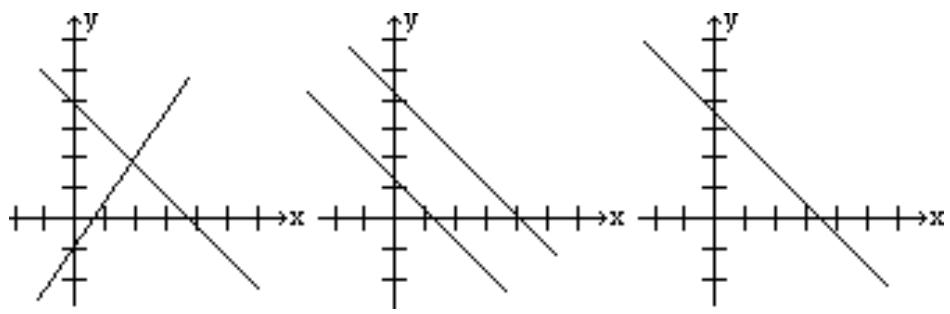
Every system of equations has either one solution, no solution, or infinitely many solutions.
In the last section, we used the Gauss-Jordan method to solve systems that had exactly one solution. In this section, we will determine the systems that have no solution, and solve the systems that have infinitely many solutions.
Solve the following system of equations:
\[x + y = 7\] \[x + y = 9\]Example 2.3.1 Solution
Let us use the Gauss-Jordan method to solve this system. The augmented matrix is
\[\left[ \begin{array}{c c | c} 1 & 1 & 7 \\ 1 & 1 & 9 \end{array} \right]\]If we multiply the first row by \(-1\) and add to the second row, we get
\[\left[ \begin{array}{c c | c} 1 & 1 & 7 \\ 0 & 0 & 2 \end{array} \right]\]The last row reads \(0x + 0y = 2\). Since 0 cannot equal 2, the last equation cannot be true for any choices of \(x\) and \(y\).
Alternatively, it is clear that the two lines are parallel; therefore, they do not intersect.
In the examples that follow, we are going to start using a calculator to row reduce the augmented matrix, in order to focus on understanding the answer rather than focusing on the process of carrying out the row operations.
Solve the following system of equations.
\[2x + 3y - 4z = 7\] \[3x + 4y - 2z = 9\] \[5x + 7y - 6z = 20\]Example 2.3.2 Solution
We enter the following augmented matrix in the calculator.
\[\left[ \begin{array}{c c c | c} 2 & 3 & -4 & 7 \\ 3 & 4 & -2 & 9 \\ 5 & 7 & -6 & 20 \end{array} \right]\]Now by pressing the key to obtain the reduced row-echelon form, we get
\[\left[ \begin{array}{c c c | c} 1 & 0 & 10 & 0 \\ 0 & 1 & -8 & 0 \\ 0 & 0 & 0 & 1 \end{array} \right]\]The last row states that \(0x + 0y + 0z = 1\), which is \(0 = 1\), a contradiction. The system is inconsistent; there is no solution.
Solve the following system of equations.
\[x + y = 7\] \[x + y = 7\]Example 2.3.3 Solution
The two lines coincide, so they intersect at infinitely many points. The reduced row-echelon form is:
\[\left[ \begin{array}{c c | c} 1 & 1 & 7 \\ 0 & 0 & 0 \end{array} \right]\]The row of all zeros provides no information. We have one equation with two variables, so we express the solution parametrically. Let \(y = t\), then \(x = 7 - t\).
Parametric Solution: \(x = 7 - t, \quad y = t\)
Solve the following system of equations.
\[x + y + z = 2\] \[2x + y - z = 3\] \[3x + 2y = 5\]Example 2.3.4 Solution
The augmented matrix and the reduced row-echelon form are:
\[\left[ \begin{array}{c c c | c} 1 & 1 & 1 & 2 \\ 2 & 1 & -1 & 3 \\ 3 & 2 & 0 & 5 \end{array} \right] \xrightarrow{\text{RREF}} \left[ \begin{array}{c c c | c} 1 & 0 & -2 & 1 \\ 0 & 1 & 3 & 1 \\ 0 & 0 & 0 & 0 \end{array} \right]\]The last equation drops out. Let \(z = t\). Then \(x = 1 + 2t\) and \(y = 1 - 3t\).
Parametric Solution: \(x = 1 + 2t, \quad y = 1 - 3t, \quad z = t\)
For example: \(t = 2\) gives \((5, -5, 2)\); \(t = 0\) gives \((1, 1, 0)\).
Solve the following system of equations.
\[x + 2y - 3z = 5\] \[2x + 4y - 6z = 10\] \[3x + 6y - 9z = 15\]Example 2.3.5 Solution
The reduced row-echelon form is:
\[\left[ \begin{array}{c c c | c} 1 & 2 & -3 & 5 \\ 0 & 0 & 0 & 0 \\ 0 & 0 & 0 & 0 \end{array} \right]\]One equation, three variables. The answer requires two parameters. Let \(z = t\) and \(y = s\).
Parametric Solution: \(x = 5 - 2s + 3t, \quad y = s, \quad z = t\)
We summarize our discussion in the following table.
- If any row of the reduced row-echelon form gives a false statement such as \(0 = 1\), the system is inconsistent and has no solution.
- If the reduced row echelon form has fewer equations than variables and the system is consistent, the system has infinitely many solutions.
- The solution must be expressed in parametric form.
- The number of arbitrary parameters equals the number of variables minus the number of equations.
Problem Set 2.3
Solve the following inconsistent or dependent systems by using the Gauss-Jordan method.
1) \(\begin{cases} 2x + 6y = 8 \\ x + 3y = 4 \end{cases}\)
Problem 1 Solution
Step 1: Write the augmented matrix and row reduce.
\[\left[\begin{array}{cc|c} 1 & 3 & 4 \\ 0 & 0 & 0 \end{array}\right]\]Step 2: The second row drops out. One equation, two unknowns. Let \(y = t\), then \(x = 4 - 3t\).
Answer: Dependent. \(x = 4 - 3t,\; y = t\).
2) The sum of digits of a two digit number is 9. The sum of the number and the number obtained by interchanging the digits is 99. Find the number.
Problem 2 Solution
Let \(x\) = tens digit, \(y\) = units digit. Both equations reduce to \(x + y = 9\).
This is a dependent system. With digit constraints, the valid numbers are: 18, 27, 36, 45, 54, 63, 72, 81, 90.
3) \(\begin{cases} 2x - y = 10 \\ -4x + 2y = 15 \end{cases}\)
Problem 3 Solution
Row reduce: second row becomes \([0,\; 0\;|\; 35]\), giving \(0 = 35\), a contradiction.
The lines are parallel (both have slope 2 but different intercepts).
Answer: Inconsistent. No solution.
4) \(\begin{cases} x + y + z = 6 \\ 3x + 2y + z = 14 \\ 4x + 3y + 2z = 20 \end{cases}\)
Problem 4 Solution
RREF:
\[\left[\begin{array}{ccc|c} 1 & 0 & -1 & 2 \\ 0 & 1 & 2 & 4 \\ 0 & 0 & 0 & 0 \end{array}\right]\]Let \(z = t\). Then \(x = 2 + t\), \(y = 4 - 2t\).
Answer: Dependent. \(x = 2+t,\; y = 4-2t,\; z = t\).
5) \(\begin{cases} x + 2y - 4z = 1 \\ 2x - 3y + 8z = 9 \end{cases}\)
Problem 5 Solution
RREF:
\[\left[\begin{array}{ccc|c} 1 & 0 & \frac{4}{7} & 3 \\ 0 & 1 & -\frac{16}{7} & -1 \end{array}\right]\]Let \(z = t\). Then \(x = 3 - \frac{4}{7}t\), \(y = -1 + \frac{16}{7}t\).
Answer: Dependent. \(x = 3 - \frac{4}{7}t,\; y = -1 + \frac{16}{7}t,\; z = t\).
6) Jessica has a collection of 15 coins consisting of nickels, dimes and quarters. If the total worth of the coins is $1.80, how many are there of each? Find all three solutions.
Problem 6 Solution
Let \(n\) = nickels, \(d\) = dimes, \(q\) = quarters. Parametric: \(n = -6+3t,\; d = 21-4t,\; q = t\).
With at least one of each coin, \(t \in \{3,4,5\}\):
- 3 nickels, 9 dimes, 3 quarters
- 6 nickels, 5 dimes, 4 quarters
- 9 nickels, 1 dime, 5 quarters
7) A company is analyzing sales reports for three products: products X, Y, Z. One report shows that a combined total of 20,000 of items X, Y, and Z were sold. Another report shows that the sum of the number of item Z sold and twice the number of item X sold equals 10,000. Also item X has 5,000 more items sold than item Y. Are these reports consistent?
Problem 7 Solution
Row reduction yields \(0 = 15{,}000\), a contradiction.
Answer: Inconsistent. The reports are not consistent.
8) \(\begin{cases} x + y + 2z = 0 \\ x + 2y + z = 0 \\ 2x + 3y + 3z = 0 \end{cases}\)
Problem 8 Solution
RREF:
\[\left[\begin{array}{ccc|c} 1 & 0 & 3 & 0 \\ 0 & 1 & -1 & 0 \\ 0 & 0 & 0 & 0 \end{array}\right]\]Let \(z = t\). Then \(x = -3t\), \(y = t\). Trivial solution at \(t = 0\).
Answer: Dependent. \(x = -3t,\; y = t,\; z = t\).
9) Find three solutions to the following system of equations: \(\begin{cases} x + 2y + z = 12 \\ y = 3 \end{cases}\)
Problem 9 Solution
Row reduce: \(x + z = 6,\; y = 3\). Let \(z = t\), \(x = 6-t\).
Three solutions: \((6,3,0)\), \((4,3,2)\), \((7,3,-1)\).
10) \(\begin{cases} x + 2y = 5 \\ 2x + 4y = k \end{cases}\)
For what values of \(k\) does this system of equations have:
- No solution?
- Infinitely many solutions?
Problem 10 Solution
Row reduce: second row becomes \([0, 0 \;|\; k-10]\).
(a) No solution when \(k \neq 10\). (b) Infinitely many when \(k = 10\).
11) \(x + 3y - z = 5\)
Problem 11 Solution
One equation, three unknowns. Two free parameters: let \(y = s\), \(z = t\).
Answer: \(x = 5 - 3s + t,\; y = s,\; z = t\).
12) Why is it not possible for a linear system to have exactly two solutions? Explain geometrically.
Problem 12 Solution
Two lines can only: (1) intersect at one point, (2) be parallel (no solution), or (3) coincide (infinitely many). There is no configuration giving exactly two intersection points.
Algebraically: if \(\mathbf{u}\) and \(\mathbf{v}\) are two distinct solutions, then \(c\mathbf{u} + (1-c)\mathbf{v}\) is also a solution for any \(c\), producing infinitely many solutions.