Supp.1 Graphing Inequalities
Source: OpenStax Intermediate Algebra 2e, Sections 2.5, 3.4, 4.7
Graphing Linear Inequalities in One Variable
What Is a Linear Inequality?
Source: OpenStax Intermediate Algebra 2e, Section 2.5
You already know how to work with linear equations — statements like \(x + 3 = 7\) where an equals sign (\(=\)) tells you two expressions have the same value. A linear inequality is almost the same idea, except instead of asking "when are these equal?", we ask "when is one side bigger (or smaller) than the other?"
We use four inequality symbols to express this:
| Symbol | Meaning | Example |
|---|---|---|
| \(>\) | greater than | \(x > 3\) |
| \(<\) | less than | \(x < 5\) |
| \(\geq\) | greater than or equal to | \(x \geq -2\) |
| \(\leq\) | less than or equal to | \(x \leq 7\) |
Here is the crucial difference between equations and inequalities: an equation like \(x = 3\) typically has one solution. An inequality like \(x > 3\) has infinitely many solutions — the numbers \(4\), \(6\), \(37\), \(3.001\), and every other number greater than three all work.

Why should you care about inequalities? In the real world, you rarely need things to be exactly equal. Instead, you need budgets that stay under a limit, test scores that are at least a passing grade, or doses that don't exceed a safe amount. Inequalities are the mathematical tool for expressing these everyday constraints.
Think of an equation as a single point on a number line, while an inequality is an entire region. An equation says "stand right here." An inequality says "you can stand anywhere in this zone."
Number Line Representation
Once you have an inequality, you need a way to visualize which numbers satisfy it. We do this by shading a region on the number line.
There are two types of endpoints:
Number Line Endpoint Rules
- Open circle (parenthesis): Used for strict inequalities (\(>\) or \(<\)). The endpoint is not included in the solution.
- Closed circle (bracket): Used for non-strict inequalities (\(\geq\) or \(\leq\)). The endpoint is included in the solution.
Graphing \(x > 3\): We shade all numbers to the right of \(3\) and place an open parenthesis at \(3\), because \(3\) itself does not satisfy \(x > 3\).

Graphing \(x \leq 1\): We shade all numbers to the left of \(1\) and place a closed bracket at \(1\), because \(1\) does satisfy \(x \leq 1\).

A quick memory trick: if the inequality symbol has a line under it (\(\leq\) or \(\geq\)), the endpoint is included — think of that little line as the bottom of a bracket. If there is no line (\(<\) or \(>\)), the endpoint is excluded — use an open circle.
Try It Now — Number Line Graphs
Graph \(x \geq -1\) on a number line. Should the circle at \(-1\) be open or closed? Which direction do you shade?
Solution
Since the inequality is \(x \geq -1\), we use a closed circle (bracket) at \(-1\) because \(-1\) is included. We shade to the right because we want all numbers greater than or equal to \(-1\).
Interval Notation
Source: OpenStax Intermediate Algebra 2e, Section 2.5
Writing out "all numbers greater than \(3\)" every time is tedious. Interval notation gives us a compact shorthand for expressing solution sets of inequalities. You write two numbers separated by a comma, wrapped in parentheses or brackets, to describe a range.
| Inequality | Number Line | Interval Notation |
|---|---|---|
| \(x > 3\) | Open circle at 3, shade right | \((3, \infty)\) |
| \(x \leq 1\) | Closed bracket at 1, shade left | \((-\infty, 1]\) |
| \(x \geq -2\) | Closed bracket at \(-2\), shade right | \([-2, \infty)\) |
| \(x < 5\) | Open circle at 5, shade left | \((-\infty, 5)\) |
Key Notation Rules
- A parenthesis \((\) \()\) means the endpoint is excluded.
- A bracket \([\) \(]\) means the endpoint is included.
- Infinity (\(\infty\)) and negative infinity (\(-\infty\)) always use parentheses because infinity is not an actual number — you can never reach it, so you can never "include" it.
Interval notation is like giving directions: \((3, \infty)\) means "start just past \(3\) and keep going forever to the right." The parenthesis at \(3\) tells you not to stop at \(3\) itself, and the parenthesis at \(\infty\) reminds you that you never actually arrive at infinity.
Try It Now — Interval Notation
Write \(x \geq 7\) in interval notation. Does \(7\) get a parenthesis or a bracket?
Solution
Since \(\geq\) means "greater than or equal to," the number \(7\) is included. We use a bracket:
\[[7, \infty)\]Compound Inequalities
Source: OpenStax Intermediate Algebra 2e, Section 2.5
A compound inequality (also called a double inequality) pins a variable between two boundaries. Instead of saying "\(x\) is bigger than \(2\) AND \(x\) is smaller than \(5\)," we write it in one clean statement:
\[2 < x < 5\]This tells us that \(x\) lives somewhere between \(2\) and \(5\), but is not equal to either endpoint.
To graph a compound inequality, shade the region between the two endpoints. The type of circle at each endpoint depends on whether that boundary is strict (\(<\) or \(>\)) or inclusive (\(\leq\) or \(\geq\)).

Compound inequalities show up whenever you have a "range" or "window" of acceptable values. For example, a healthy body temperature is between \(97.8°\text{F}\) and \(99.1°\text{F}\), a pH between \(6.5\) and \(7.5\) is considered neutral, and a passing exam score might need to be between \(60\) and \(100\). All of these are compound inequalities in disguise.
Try It Now — Compound Inequalities
Write the compound inequality \(-4 \leq x < 2\) in interval notation. What symbols go at \(-4\) and at \(2\)?
Solution
- \(-4\) uses \(\leq\), so it is included → bracket
- \(2\) uses \(<\), so it is excluded → parenthesis
Source: OpenStax Intermediate Algebra 2e, Section 2.5
Graph each inequality on the number line and express in interval notation.
(a) \(x \geq -3\) (b) \(x < 2.5\) (c) \(x \leq -\frac{3}{5}\)
Example 0.1.1 Solution
(a) \(x \geq -3\)
- Shade to the right of \(-3\).
- Place a bracket at \(-3\) (since \(-3\) is included).
- Interval notation: \([-3, \infty)\)
(b) \(x < 2.5\)
- Shade to the left of \(2.5\).
- Place a parenthesis at \(2.5\) (since \(2.5\) is not included).
- Interval notation: \((-\infty, 2.5)\)
(c) \(x \leq -\frac{3}{5}\)
- Shade to the left of \(-\frac{3}{5}\).
- Place a bracket at \(-\frac{3}{5}\) (since \(-\frac{3}{5}\) is included).
- Interval notation: \(\left(-\infty, -\frac{3}{5}\right]\)
Source: OpenStax Intermediate Algebra 2e, Section 2.5
Graph each compound inequality and express in interval notation.
(a) \(-3 < x < 4\) (b) \(-6 \leq x < -1\) (c) \(0 \leq x \leq 2.5\)
Example 0.1.2 Solution
(a) \(-3 < x < 4\)
- Shade between \(-3\) and \(4\).
- Parentheses at both \(-3\) and \(4\) (neither is included).
- Interval notation: \((-3, 4)\)
(b) \(-6 \leq x < -1\)
- Shade between \(-6\) and \(-1\).
- Bracket at \(-6\) (included), parenthesis at \(-1\) (excluded).
- Interval notation: \([-6, -1)\)
(c) \(0 \leq x \leq 2.5\)
- Shade between \(0\) and \(2.5\).
- Brackets at both endpoints (both are included).
- Interval notation: \([0, 2.5]\)
Solving Linear Inequalities
Solving an inequality works almost exactly like solving an equation — your goal is to isolate the variable on one side. You can add, subtract, multiply, and divide just like before, with one critical exception that trips up many students.
Two key properties govern how we manipulate inequalities:
The Addition Property
Source: OpenStax Intermediate Algebra 2e, Section 2.5
For any numbers \(a\), \(b\), and \(c\):
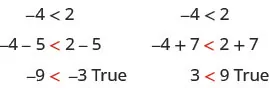
\[\text{If } a < b, \text{ then } a + c < b + c \text{ and } a - c < b - c\] \[\text{If } a > b, \text{ then } a + c > b + c \text{ and } a - c > b - c\]In plain English: adding or subtracting the same value on both sides of an inequality does not change the direction of the inequality. This works exactly the same way as with equations — no surprises here.
The Multiplication Property
Source: OpenStax Intermediate Algebra 2e, Section 2.5
The Multiplication/Division Rules for Inequalities
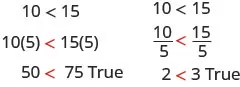
- Multiplying or dividing by a positive number: The inequality direction stays the same.
- If \(a < b\) and \(c > 0\), then \(ac < bc\) and \(\frac{a}{c} < \frac{b}{c}\).
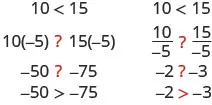
- Multiplying or dividing by a negative number: The inequality direction reverses.
- If \(a < b\) and \(c < 0\), then \(ac > bc\) and \(\frac{a}{c} > \frac{b}{c}\).
⚠️ Critical Rule: When you multiply or divide both sides of an inequality by a negative number, you must flip the inequality sign. This is the single most common mistake students make with inequalities.
Why does the sign flip? Think about it with real numbers. We know \(2 < 5\). Now multiply both sides by \(-1\): we get \(-2\) and \(-5\). On the number line, \(-2\) is to the right of \(-5\), so \(-2 > -5\). Multiplying by a negative literally mirrors the number line, swapping left and right — so the direction of the inequality must reverse.

Try It Now — Sign Flip Practice
Start with the true statement \(4 < 10\). Multiply both sides by \(-3\). What inequality do you get? Did you remember to flip the sign?
Solution
Multiplying both sides by \(-3\):
\[4 \times (-3) = -12 \quad \text{and} \quad 10 \times (-3) = -30\]Since we multiplied by a negative, we flip the inequality:
\[-12 > -30\]Check: \(-12\) is to the right of \(-30\) on the number line, so \(-12 > -30\) is correct. ✓
Source: OpenStax Intermediate Algebra 2e, Section 2.5
Solve each inequality, graph the solution, and write in interval notation.
(a) \(x - \frac{3}{8} \leq \frac{3}{4}\) (b) \(9y < 54\) (c) \(-15 < \frac{3}{5}z\)
Example 0.1.3 Solution
(a) \(x - \frac{3}{8} \leq \frac{3}{4}\)
| Step | Work |
|---|---|
| Add \(\frac{3}{8}\) to both sides | \(x \leq \frac{3}{4} + \frac{3}{8}\) |
| Find common denominator and simplify | \(x \leq \frac{6}{8} + \frac{3}{8} = \frac{9}{8}\) |
| Interval notation | \(\left(-\infty, \frac{9}{8}\right]\) |
(b) \(9y < 54\)
| Step | Work |
|---|---|
| Divide both sides by \(9\) (positive — inequality stays) | \(y < 6\) |
| Interval notation | \((-\infty, 6)\) |
(c) \(-15 < \frac{3}{5}z\)
| Step | Work |
|---|---|
| Multiply both sides by \(\frac{5}{3}\) (positive — inequality stays) | \(-25 < z\) |
| Rewrite with variable on left | \(z > -25\) |
| Interval notation | \((-25, \infty)\) |

Try It Now — One-Step Inequality
Solve \(x + 7 > 12\) and write the answer in interval notation.
Solution
Subtract \(7\) from both sides:
\[x > 12 - 7\] \[x > 5\]Interval notation: \((5, \infty)\)
Source: OpenStax Intermediate Algebra 2e, Section 2.5
Solve each inequality, graph the solution, and write in interval notation.
(a) \(-13m \geq 65\) (b) \(\frac{n}{-2} \geq 8\)
Example 0.1.4 Solution
(a) \(-13m \geq 65\)
| Step | Work |
|---|---|
| Divide both sides by \(-13\) | \(m \leq -5\) |
| Flip the inequality (dividing by a negative) | \(m \leq -5\) |
| Interval notation | \((-\infty, -5]\) |
(b) \(\frac{n}{-2} \geq 8\)
| Step | Work |
|---|---|
| Multiply both sides by \(-2\) | \(n \leq -16\) |
| Flip the inequality (multiplying by a negative) | \(n \leq -16\) |
| Interval notation | \((-\infty, -16]\) |

Notice the pattern: every time a negative number is involved in multiplication or division, the inequality flips. A good habit is to circle or highlight the negative divisor/multiplier as a reminder to flip the sign before writing your answer.
Try It Now — Negative Division
Solve \(-5x \leq 20\). Be careful with the sign!
Solution
Divide both sides by \(-5\). Since \(-5\) is negative, flip the inequality:
\[x \geq \frac{20}{-5}\] \[x \geq -4\]Interval notation: \([-4, \infty)\)
Source: OpenStax Intermediate Algebra 2e, Section 2.5
Solve \(8p + 3(p - 12) > 7p - 28\), graph on the number line, and write in interval notation.
Example 0.1.5 Solution
| Step | Work |
|---|---|
| Start | \(8p + 3(p - 12) > 7p - 28\) |
| Distribute the \(3\) | \(8p + 3p - 36 > 7p - 28\) |
| Combine like terms on the left | \(11p - 36 > 7p - 28\) |
| Subtract \(7p\) from both sides | \(4p - 36 > -28\) |
| Add \(36\) to both sides | \(4p > 8\) |
| Divide both sides by \(4\) (positive — sign stays) | \(p > 2\) |
| Interval notation | \((2, \infty)\) |

Multi-step inequalities follow the same strategy as multi-step equations: distribute first, combine like terms, then isolate the variable. The only extra step is watching for multiplication or division by a negative.
Try It Now — Multi-Step Inequality
Solve \(3(x + 4) - 2x \geq 10\) and write in interval notation.
Solution
- Distribute: \(3x + 12 - 2x \geq 10\)
- Combine like terms: \(x + 12 \geq 10\)
- Subtract \(12\): \(x \geq -2\)
Interval notation: \([-2, \infty)\)
Source: OpenStax Intermediate Algebra 2e, Section 2.5
Solve \(8x - 2(5 - x) < 4(x + 9) + 6x\), graph, and write in interval notation.
Example 0.1.6 Solution
| Step | Work |
|---|---|
| Start | \(8x - 2(5 - x) < 4(x + 9) + 6x\) |
| Distribute | \(8x - 10 + 2x < 4x + 36 + 6x\) |
| Combine like terms | \(10x - 10 < 10x + 36\) |
| Subtract \(10x\) from both sides | \(-10 < 36\) |
| Result: A true statement! | The inequality is an identity. |
| Solution: All real numbers | \((-\infty, \infty)\) |
Identity vs. No Solution
When the variable cancels out during solving, you get one of two outcomes:
- True statement (like \(-10 < 36\)): The inequality is an identity — it holds for all real numbers. Solution: \((-\infty, \infty)\).
- False statement (like \(0 > 5\)): The inequality is a contradiction — there is no solution. Solution: \(\emptyset\) (the empty set).

This is the inequality version of a concept you've seen with equations. Remember when solving an equation led to \(0 = 0\) (true for all \(x\)) or \(0 = 5\) (no solution)? The same logic applies here — if the variable drops out, the truth of the remaining statement determines whether every number works or no number works.
Try It Now — Identity or Contradiction?
Solve \(2(x + 3) > 2x + 10\). Is the result an identity, a contradiction, or a normal solution?
Solution
- Distribute: \(2x + 6 > 2x + 10\)
- Subtract \(2x\): \(6 > 10\)
- This is a false statement.
The inequality is a contradiction — there is no solution. \(\emptyset\)
Translating Words to Inequalities
Many real-world problems come to you in words, not symbols. To solve them, you first need to translate English phrases into mathematical inequalities. Here are the key phrases to watch for:
| \(>\) (greater than) | \(\geq\) (greater than or equal to) | \(<\) (less than) | \(\leq\) (less than or equal to) |
|---|---|---|---|
| is more than | is at least | is smaller than | is at most |
| is larger than | is no less than | has fewer than | is no more than |
| exceeds | is the minimum | is lower than | is the maximum |
Inequality Translation Terminology
- "at least" means \(\geq\) — the value can equal the number or be larger. Think: "at least 18" means 18 or older.
- "at most" means \(\leq\) — the value can equal the number or be smaller. Think: "at most $50" means $50 or less.
- "more than" and "fewer than" are strict — they use \(>\) and \(<\) without the "or equal to."
- "no less than" is another way of saying \(\geq\), and "no more than" is another way of saying \(\leq\).
Translation skills are essential because real-world constraints almost always come in words. A contract might say "delivery must take no more than 5 business days" (\(d \leq 5\)), a recipe might require "at least 2 cups of flour" (\(f \geq 2\)), or a speed limit sign says you can drive "up to 65 mph" (\(s \leq 65\)). Recognizing these phrases is the bridge between everyday language and mathematical problem-solving.
Try It Now — Translation Practice
Translate into a mathematical inequality: "A student needs at least 70 points to pass the course." Use \(p\) for the number of points.
Solution
"At least" means \(\geq\), so:
\[p \geq 70\]Source: OpenStax Intermediate Algebra 2e, Section 2.5
Twenty-seven less than \(x\) is at least \(48\). Translate, solve, graph, and write in interval notation.
Example 0.1.7 Solution
| Step | Work |
|---|---|
| Translate: "27 less than \(x\)" → \(x - 27\); "is at least" → \(\geq\) | \(x - 27 \geq 48\) |
| Add \(27\) to both sides | \(x \geq 75\) |
| Interval notation | \([75, \infty)\) |

Watch the word order carefully! "27 less than \(x\)" means \(x - 27\), not \(27 - x\). The phrase "less than" in translation problems means "subtract from," with the variable coming first. This is a common trap.
Applications of Linear Inequalities
Real-world problems often require finding a maximum or minimum number of items, hours, or quantities that satisfy a constraint. These are perfect situations for linear inequalities.
Application problems are where inequalities truly shine. Every time you ask "how many can I afford?" or "how much do I need to earn?", you are setting up an inequality. The math you learn here applies directly to budgeting, business planning, and everyday decision-making.
Try It Now — Setting Up an Application
You have $200 to spend on books that cost $12.50 each. Write an inequality that represents this situation. (Let \(b\) = number of books.)
Solution
The total cost must be at most $200:
\[12.50b \leq 200\](Solving: \(b \leq 16\), so you can buy at most 16 books.)
Source: OpenStax Intermediate Algebra 2e, Section 2.5
Dawn won a mini-grant of $4,000 to buy tablet computers for her classroom. Each tablet costs $254.12, including tax and delivery. What is the maximum number of tablets she can buy?
Example 0.1.8 Solution
| Step | Work |
|---|---|
| Let \(n\) = the number of tablets | |
| Write the inequality: cost per tablet × quantity ≤ budget | \(254.12n \leq 4000\) |
| Divide both sides by \(254.12\) | \(n \leq 15.74\) |
| Since \(n\) must be a whole number, round down | \(n \leq 15\) |
| Answer: Dawn can buy at most 15 tablets |
Check: \(15 \times 254.12 = \$3{,}811.80 \leq \$4{,}000\) ✓ \(16 \times 254.12 = \$4{,}065.92 > \$4{,}000\) ✗
When an application problem asks for a number of physical items (tablets, people, boxes), you must round down to the nearest whole number for "at most" problems and round up for "at least" problems. You can't buy \(15.74\) tablets!
Source: OpenStax Intermediate Algebra 2e, Section 2.5
Taleisha's phone plan charges $28.80 per month plus $0.20 per text message. How many texts can she send while keeping her monthly bill no more than $50?
Example 0.1.9 Solution
| Step | Work |
|---|---|
| Let \(t\) = the number of text messages | |
| Monthly cost: base + per-text charge | \(28.80 + 0.20t \leq 50\) |
| Subtract \(28.80\) from both sides | \(0.20t \leq 21.20\) |
| Divide both sides by \(0.20\) | \(t \leq 106\) |
| Answer: Taleisha can send at most 106 text messages |
Source: OpenStax Intermediate Algebra 2e, Section 2.5
Felicity runs a calligraphy business, charging $2.50 per wedding invitation. Her monthly expenses are $650. How many invitations must she write to earn a profit of at least $2,800 per month?
Example 0.1.10 Solution
| Step | Work |
|---|---|
| Let \(n\) = the number of invitations | |
| Profit = Revenue − Expenses | \(2.50n - 650 \geq 2800\) |
| Add \(650\) to both sides | \(2.50n \geq 3450\) |
| Divide both sides by \(2.50\) | \(n \geq 1380\) |
| Answer: Felicity must write at least 1,380 invitations |

Summary of Key Properties
| Property | Rule | Example |
|---|---|---|
| Addition/Subtraction | Add or subtract the same value — direction unchanged | \(x - 5 > 3 \Rightarrow x > 8\) |
| Multiply/Divide by positive | Direction unchanged | \(3x \leq 12 \Rightarrow x \leq 4\) |
| Multiply/Divide by negative | Reverse the inequality | \(-2x > 6 \Rightarrow x < -3\) |
General Solving Strategy for Linear Inequalities
- Simplify each side separately (distribute, combine like terms).
- Collect variable terms on one side using the Addition Property.
- Collect constants on the other side using the Addition Property.
- Isolate the variable using the Multiplication/Division Property.
- If multiplying or dividing by a negative, flip the inequality sign.
- Graph the solution on a number line.
- Write the solution in interval notation.

Graphing Linear Inequalities in Two Variables
What Is a Linear Inequality in Two Variables?
Up to now, we have graphed linear equations — and their solutions form a straight line. But what happens when we replace the equals sign with an inequality symbol like \(>\), \(<\), \(\geq\), or \(\leq\)? Instead of a single line of solutions, we get an entire region of the coordinate plane. Every point in that region satisfies the inequality.
Why does this matter? In the real world, constraints are rarely exact equalities. A budget might require you to spend at most a certain amount. A recipe might call for at least a certain quantity of an ingredient. A factory might need to produce more than a minimum number of units. Graphing inequalities lets you visualize all the combinations that satisfy a constraint — not just one precise answer, but a whole region of possibilities.
Source: OpenStax Intermediate Algebra 2e, Section 3.4
A linear inequality in two variables is an inequality that can be written in one of the following forms:
\[Ax + By > C \qquad Ax + By \geq C \qquad Ax + By < C \qquad Ax + By \leq C\]where \(A\) and \(B\) are not both zero.
In plain terms: take any linear equation \(Ax + By = C\) and swap the \(=\) for one of the four inequality symbols. That gives you a linear inequality in two variables.
Think of a linear equation as a fence running across a field. The equation tells you exactly where the fence is. A linear inequality tells you which side of the fence you're allowed to be on — and sometimes whether you can stand on the fence itself.
Checking Solutions
Source: OpenStax Intermediate Algebra 2e, Section 3.4
An ordered pair \((x, y)\) is a solution to a linear inequality if the inequality is a true statement when we substitute the values of \(x\) and \(y\).
To check whether a point is a solution, you simply plug in the coordinates and see if the resulting statement is true. Let's test several points against the inequality \(y > x + 4\):
| Point | Substitution | True? |
|---|---|---|
| \((0, 0)\) | \(0 > 0 + 4 \implies 0 > 4\) | No |
| \((1, 6)\) | \(6 > 1 + 4 \implies 6 > 5\) | Yes |
| \((2, 6)\) | \(6 > 2 + 4 \implies 6 > 6\) | No (equal, not strictly greater) |
| \((-5, -15)\) | \(-15 > -5 + 4 \implies -15 > -1\) | No |
| \((-8, 12)\) | \(12 > -8 + 4 \implies 12 > -4\) | Yes |
Notice something important: the two solutions — \((1, 6)\) and \((-8, 12)\) — both lie on the same side of the line \(y = x + 4\). The non-solutions all lie on the opposite side. This is not a coincidence — it is the key idea behind graphing inequalities.
Every linear inequality divides the coordinate plane into two halves. All solutions live on one side, and all non-solutions live on the other. Once you know which side is which, you can shade the entire region without checking every single point.
Try It Now 0.1
Source: OpenStax Intermediate Algebra 2e, Section 3.4
Determine whether each point is a solution to \(y \leq 2x - 3\): (a) \((4, 1)\), (b) \((0, 0)\), (c) \((2, 1)\).
Solution
(a) Substitute \((4, 1)\): \(1 \leq 2(4) - 3 = 5\). Since \(1 \leq 5\) is true, yes, \((4, 1)\) is a solution.
(b) Substitute \((0, 0)\): \(0 \leq 2(0) - 3 = -3\). Since \(0 \leq -3\) is false, no, \((0, 0)\) is not a solution.
(c) Substitute \((2, 1)\): \(1 \leq 2(2) - 3 = 1\). Since \(1 \leq 1\) is true (equality counts for \(\leq\)), yes, \((2, 1)\) is a solution.
The Boundary Line
When you graph a linear inequality, the first thing you draw is the boundary line. This is the line you get when you replace the inequality symbol with an equals sign.
Source: OpenStax Intermediate Algebra 2e, Section 3.4
The line \(Ax + By = C\) is the boundary line that separates the coordinate plane into two half-planes:
- One half-plane where \(Ax + By > C\)
- The other half-plane where \(Ax + By < C\)
Whether the boundary line itself is part of the solution set depends on the inequality symbol:
Solid vs. Dashed Boundary Lines
| Inequality Type | Symbol | Boundary Line Style | Boundary Included? |
|---|---|---|---|
| Strict | \(<\) or \(>\) | Dashed line | No — points on the line are NOT solutions |
| Non-strict | \(\leq\) or \(\geq\) | Solid line | Yes — points on the line ARE solutions |
This works exactly like open and closed circles on a number line. A closed circle (●) means "this point is included" — that's your solid line. An open circle (○) means "this point is NOT included" — that's your dashed line. Same idea, just extended to two dimensions.
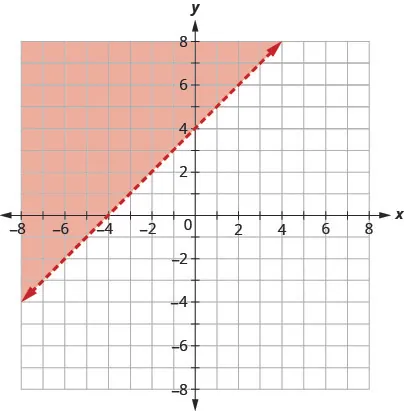
Figure: A dashed boundary line indicates a strict inequality — points on the line are NOT solutions.
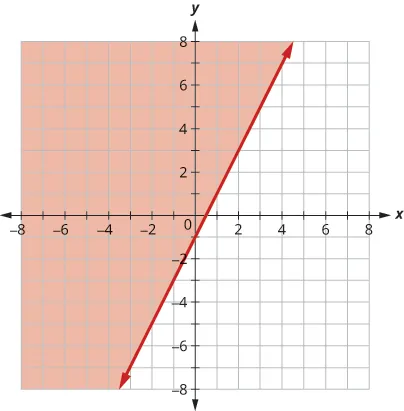
Figure: A solid boundary line indicates a non-strict inequality (\(\leq\) or \(\geq\)) — points on the line ARE solutions.
Try It Now 0.2
Source: OpenStax Intermediate Algebra 2e, Section 3.4
For each inequality, state whether the boundary line should be solid or dashed: (a) \(y < 3x + 1\), (b) \(2x + y \geq 7\), (c) \(x > -4\).
Solution
(a) The symbol is \(<\) (strict), so the boundary line \(y = 3x + 1\) is dashed.
(b) The symbol is \(\geq\) (non-strict), so the boundary line \(2x + y = 7\) is solid.
(c) The symbol is \(>\) (strict), so the boundary line \(x = -4\) is dashed.
The Test Point Method
Once you have drawn the boundary line, you need to figure out which side of it to shade. The test point method gives you a quick, reliable way to do this.
The Test Point Method
- Pick any test point that is NOT on the boundary line. The point \((0, 0)\) is usually the easiest choice — unless the boundary line passes through the origin.
- Substitute the test point's coordinates into the original inequality.
- If the inequality is true, shade the side of the boundary line that contains the test point.
- If the inequality is false, shade the opposite side — the half-plane that does NOT contain the test point.
Why does testing just one point work? Because a straight line splits the plane into exactly two halves. Every point on a given side produces the same true/false result. So if one point on a side makes the inequality true, every point on that side makes it true.
Key Tip — When the Line Passes Through the Origin: If the boundary line goes through \((0, 0)\), you cannot use the origin as your test point (it's on the line, not on either side). Choose another convenient point like \((1, 0)\) or \((0, 1)\) instead.
Try It Now 0.3
Source: OpenStax Intermediate Algebra 2e, Section 3.4
The boundary line for \(3x - y = 6\) has been drawn. Use the test point \((0, 0)\) to determine which side to shade for the inequality \(3x - y < 6\).
Solution
Substitute \((0, 0)\): \(3(0) - 0 = 0 < 6\). This is true, so we shade the side of the line that contains \((0, 0)\).
Steps for Graphing a Linear Inequality
Here is the complete procedure, combining everything we have learned:
How to Graph a Linear Inequality in Two Variables
Step 1. Draw the boundary line.
- Replace the inequality symbol with \(=\) to get the boundary equation.
- If the inequality uses \(\leq\) or \(\geq\), draw a solid line (boundary included).
- If the inequality uses \(<\) or \(>\), draw a dashed line (boundary excluded).
Step 2. Choose and test a point.
- Pick a test point that is NOT on the boundary line.
- Substitute it into the original inequality.
Step 3. Shade the correct half-plane.
- If the test point satisfies the inequality → shade the side containing the test point.
- If the test point does not satisfy the inequality → shade the opposite side.
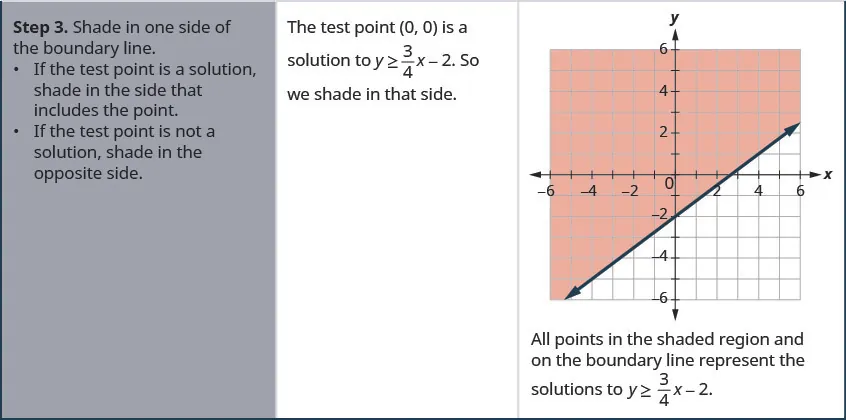
Figure: Summary of the graphing procedure — test the point, shade the correct side.
This three-step process is the same regardless of the form your inequality is in — slope-intercept, standard form, horizontal, vertical, or even an application problem. Master these three steps and you can graph any linear inequality.
Try It Now 0.4
Source: OpenStax Intermediate Algebra 2e, Section 3.4
Graph \(y > x - 1\). Identify: (a) Is the boundary line solid or dashed? (b) Which test point would you use? (c) Which side do you shade?
Solution
(a) The symbol is \(>\) (strict), so the boundary line \(y = x - 1\) is dashed.
(b) Use \((0, 0)\) since the line does not pass through the origin.
(c) Test \((0, 0)\): \(0 > 0 - 1 \implies 0 > -1\). This is true, so shade the side that contains \((0, 0)\) — the region above the line.
Source: OpenStax Intermediate Algebra 2e, Section 3.4
Graph \(y \geq \dfrac{3}{4}x - 2\).
Example 0.1.11 Solution
Step 1. Graph the boundary line \(y = \frac{3}{4}x - 2\).
- The symbol is \(\geq\) (non-strict), so draw a solid line — points on the line are included.
- The \(y\)-intercept is \((0, -2)\). The slope is \(\frac{3}{4}\), which means rise 3, run 4.
- Plot \((0, -2)\), then move up 3 and right 4 to get a second point. Connect with a solid line.
Step 2. Test the point \((0, 0)\):
\[0 \geq \frac{3}{4}(0) - 2 \implies 0 \geq -2 \quad \checkmark \text{ True}\]Step 3. Since \((0, 0)\) is a solution, shade the side of the line that includes \((0, 0)\) — the region above the line.
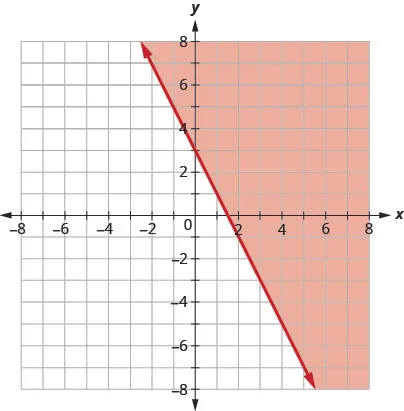
Figure: The solid boundary line includes all points on the line. The shaded region above contains all solutions.
Source: OpenStax Intermediate Algebra 2e, Section 3.4
Graph \(x - 2y < 5\).
Example 0.1.12 Solution
Step 1. Graph the boundary line \(x - 2y = 5\).
- The symbol is \(<\) (strict), so draw a dashed line — points on the line are NOT included.
- Find the intercepts:
- Set \(y = 0\): \(x = 5\), giving the point \((5, 0)\).
- Set \(x = 0\): \(-2y = 5 \implies y = -\frac{5}{2}\), giving the point \((0, -\frac{5}{2})\).
- Plot both intercepts and connect with a dashed line.
Step 2. Test the point \((0, 0)\):
\[0 - 2(0) < 5 \implies 0 < 5 \quad \checkmark \text{ True}\]Step 3. Since \((0, 0)\) is a solution, shade the side containing \((0, 0)\) — the region above the dashed line.
Source: OpenStax Intermediate Algebra 2e, Section 3.4
Graph \(y \leq -4x\) (boundary through the origin).
Example 0.1.13 Solution
Step 1. Graph the boundary line \(y = -4x\).
- The symbol is \(\leq\) (non-strict), so draw a solid line.
- This line passes through the origin \((0, 0)\) with a slope of \(-4\) (steep, falling left to right).
Step 2. Since the line passes through \((0, 0)\), we cannot use the origin as our test point. Choose \((1, 0)\) instead:
\[0 \leq -4(1) \implies 0 \leq -4 \quad \text{False}\]Step 3. Since \((1, 0)\) is NOT a solution, shade the opposite side from \((1, 0)\) — the region below and to the left of the line.
Whenever the boundary line passes through the origin, just pick a simple point like \((1, 0)\) or \((0, 1)\) as your test point. The rest of the process stays exactly the same.
Source: OpenStax Intermediate Algebra 2e, Section 3.4
Graph \(y > 3\) (horizontal boundary).
Example 0.1.14 Solution
Step 1. Graph the boundary line \(y = 3\).
- This is a horizontal line that crosses the \(y\)-axis at height 3. Every point on this line has a \(y\)-coordinate of 3.
- The symbol is \(>\) (strict), so draw a dashed line.
Step 2. Test the point \((0, 0)\):
\[0 > 3 \quad \text{False}\]Step 3. Since \((0, 0)\) is NOT a solution, shade the opposite side from \((0, 0)\) — the region above the dashed line.
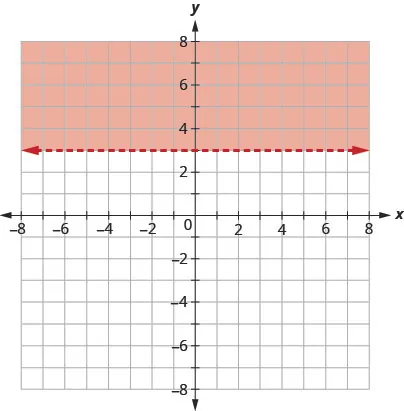
Figure: Horizontal boundary line \(y = 3\) (dashed). The shaded region above contains all points where \(y > 3\).
Horizontal and vertical boundary lines are actually the simplest cases. For \(y > 3\), you are literally asking: "Where is \(y\) bigger than 3?" The answer is everything above the line \(y = 3\). No slope calculations needed.
Source: OpenStax Intermediate Algebra 2e, Section 3.4
Hilaria works two part-time jobs to earn at least $240 per week. Her food-service job pays $10/hour and her tutoring job pays $15/hour. Let \(x\) = hours in food service and \(y\) = hours tutoring. Write and graph the inequality.
Example 0.1.15 Solution
First, we translate the word problem into an inequality. Hilaria earns \(10x\) dollars from food service and \(15y\) dollars from tutoring. She needs the total to be at least $240:
\[10x + 15y \geq 240\]Graphing:
Step 1. Graph the boundary line \(10x + 15y = 240\).
- Simplify by dividing everything by 5: \(2x + 3y = 48\).
- Find the intercepts:
- Set \(y = 0\): \(2x = 48 \implies x = 24\), giving \((24, 0)\).
- Set \(x = 0\): \(3y = 48 \implies y = 16\), giving \((0, 16)\).
- The symbol is \(\geq\), so draw a solid line.
Step 2. Test \((0, 0)\):
\[10(0) + 15(0) = 0 \geq 240 \quad \text{False}\]Step 3. Since \((0, 0)\) is NOT a solution, shade the side away from the origin.
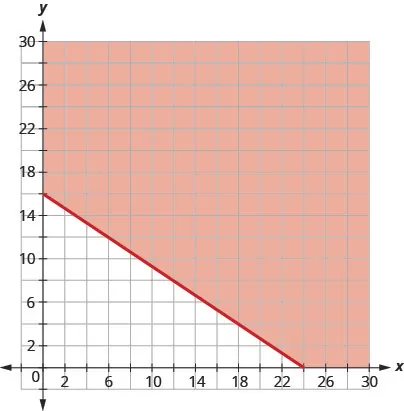
Figure: The shaded region represents all combinations of hours where Hilaria earns at least $240.
Sample solutions from the shaded region: \((10, 10)\), \((15, 6)\), \((24, 0)\) — each represents a valid combination of work hours that meets or exceeds $240.
This is one of the most common uses of linear inequalities in real life. Whenever you have two competing demands on a limited resource — time, money, materials — an inequality graph shows you all the feasible combinations at once. This is the foundation of linear programming, a technique used in business, logistics, and engineering to find optimal solutions under constraints.
Try It Now 0.5
Source: OpenStax Intermediate Algebra 2e, Section 3.4
Marcus earns $12/hour as a barista and $20/hour as a freelance designer. He wants to earn more than $300 per week. Let \(x\) = barista hours and \(y\) = design hours. (a) Write the inequality. (b) Should the boundary line be solid or dashed? (c) Does the point \((10, 10)\) satisfy the inequality?
Solution
(a) \(12x + 20y > 300\)
(b) The symbol is \(>\) (strict), so the boundary line is dashed — earning exactly $300 does not satisfy "more than."
(c) Test \((10, 10)\): \(12(10) + 20(10) = 120 + 200 = 320 > 300\). Yes, \((10, 10)\) is a solution.
Special Cases Summary
| Boundary Type | Example | Notes |
|---|---|---|
| Slope-intercept form | \(y > 2x - 1\) | Standard graphing with \(y\)-intercept and slope |
| Standard form | \(3x + 2y \leq 6\) | Find \(x\)- and \(y\)-intercepts to plot the line |
| Through the origin | \(y \leq -4x\) | Cannot use \((0,0)\) as test point — choose \((1,0)\) or \((0,1)\) |
| Horizontal line | \(y > 3\) | Boundary is \(y = 3\); shade above or below |
| Vertical line | \(x \leq -2\) | Boundary is \(x = -2\); shade left or right |
Inequality Graphing Terminology
The line you draw first is called the boundary line — it is the dividing line between solutions and non-solutions.
Each side of the boundary line is called a half-plane. One half-plane contains all the solutions; the other contains all the non-solutions.
A test point is any point not on the boundary line that you substitute into the inequality to determine which half-plane to shade.
A strict inequality (\(<\) or \(>\)) uses a dashed boundary line. A non-strict inequality (\(\leq\) or \(\geq\)) uses a solid boundary line.
Systems of Linear Inequalities
Source: OpenStax Intermediate Algebra 2e, Section 4.7
A system of linear inequalities is a set of two or more linear inequalities that must all be true at the same time. Instead of looking for a single point that solves an equation, you are looking for an entire region of points — every \((x, y)\) pair that satisfies all the inequalities simultaneously.
For example, the pair of constraints
\[x + 4y \geq 10\] \[3x - 2y < 12\]forms a system of two linear inequalities. Any ordered pair \((x, y)\) that makes both statements true is a solution to the system.
Why would you need multiple inequalities at the same time? In the real world, decisions rarely face just one constraint. A business might need to keep costs below a budget and produce at least a certain number of products. A nutritionist might plan a meal that stays under a calorie limit and provides enough protein. Systems of inequalities let you model all of these constraints at once and find the options that work for everything. This idea becomes the foundation of linear programming (Chapter 3 in this course), one of the most widely used optimization tools in business, engineering, and data science.
Checking Whether an Ordered Pair Is a Solution
To test whether a specific point belongs to the solution set, plug its coordinates into every inequality in the system. The point is a solution only if every single inequality comes out true.
Think of it like a checklist. Each inequality is one requirement. The point "passes" only if it checks every box. Even one failure disqualifies it — there is no partial credit.
Quick check: Is \((-2, 4)\) a solution to the system above?
- First inequality: \((-2) + 4(4) = 14 \geq 10\) ✓
- Second inequality: \(3(-2) - 2(4) = -14 < 12\) ✓
Both hold, so \((-2, 4)\) is a solution.
Now check \((3, 1)\):
- First inequality: \(3 + 4(1) = 7 \geq 10\) ✗
It already fails the first constraint, so \((3, 1)\) is not a solution. There is no need to check the second inequality — one failure is enough.
Try It Now 0.1.1
Source: OpenStax Intermediate Algebra 2e, Section 4.7
Is the point \((4, 2)\) a solution to the system below?
\[2x + y \leq 12\] \[x - y > 0\]Solution
Substitute \((4, 2)\) into each inequality:
- \(2(4) + 2 = 10 \leq 12\) ✓
- \(4 - 2 = 2 > 0\) ✓
Both inequalities are satisfied, so \((4, 2)\) is a solution to the system.
Source: OpenStax Intermediate Algebra 2e, Section 4.7
When you graph all the inequalities in a system on the same coordinate plane, the feasible region (also called the solution region) is the area where all the shaded regions overlap. Every point inside the feasible region satisfies every constraint. Points outside the region violate at least one inequality.
The feasible region can take two forms:
- Bounded — completely enclosed by boundary lines, forming a polygon (triangle, quadrilateral, etc.). The region has a finite area.
- Unbounded — the region extends infinitely in one or more directions. There is no polygon "cage" surrounding it.
Picture a map of a city. Zoning laws say a new store must be at least 2 miles from a school and within 5 miles of a highway. The feasible region on the map is where both rules are satisfied — that is where you are allowed to build. Every real-world constraint narrows the feasible region, and the overlap of all constraints is where your actual options live. In linear programming (Chapter 3), you will find the best option within this feasible region.
Try It Now 0.1.2
Source: OpenStax Intermediate Algebra 2e, Section 4.7
In your own words, explain the difference between a bounded and an unbounded feasible region. Then give one real-world scenario that would produce each type.
Solution
A bounded feasible region is completely enclosed — it has a finite area with clear borders on all sides. An unbounded feasible region extends to infinity in at least one direction.
- Bounded example: A factory must produce at least 10 units, at most 50 units, spend at most $500, and use at most 100 hours of labor. All four constraints "box in" the feasible region.
- Unbounded example: You must earn at least $30,000 per year and work at most 50 hours per week. There is no upper limit on income, so the region extends upward forever.
Solving a System by Graphing
Here is the step-by-step method for finding the feasible region of any system of linear inequalities:
Steps for Graphing a System of Linear Inequalities
- Graph the first inequality. Draw the boundary line (solid for \(\leq\) or \(\geq\); dashed for \(<\) or \(>\)). Shade the half-plane that satisfies the inequality.
- Graph the second inequality on the same axes. Draw its boundary line with the correct style and shade its half-plane.
- Find the overlap. The region where all shaded areas intersect is the feasible region — the complete solution set.
- Verify. Pick a test point from the overlap and substitute it into every original inequality to confirm.
If the system has more than two inequalities, repeat Steps 1–2 for each additional constraint. The feasible region is always the intersection of all shaded half-planes.
Step 1: Graph Each Boundary Line
For each inequality:
- Solve for \(y\) (slope-intercept form) if possible, so the line is easy to plot.
- Use a solid line for \(\leq\) or \(\geq\) (the boundary is included in the solution).
- Use a dashed line for \(<\) or \(>\) (the boundary is not included).
A solid line means "this boundary counts as part of the answer." A dashed line means "right up to but not including." Think of a velvet rope at a club — solid means you can stand on the rope, dashed means you have to stay behind it.
Step 2: Shade the Correct Half-Plane
- For \(y >\) or \(y \geq\): shade above the line.
- For \(y <\) or \(y \leq\): shade below the line.
- When in doubt, substitute \((0, 0)\) into the inequality. If it comes out true, shade the side containing the origin. If false, shade the opposite side.
Step 3: Identify the Overlap
The feasible region is where all shaded half-planes overlap. This is the region you highlight or mark clearly on your graph. If there is no overlap at all, the system has no solution.
Step 4: Verify with a Test Point
Choose a point clearly inside the overlap (not on a boundary line) and substitute it into every inequality. If all inequalities are satisfied, you have found the correct feasible region.
Try It Now 0.1.3
Source: OpenStax Intermediate Algebra 2e, Section 4.7
You are about to graph the system:
\[y \geq x - 1\] \[y \leq -x + 5\]Before graphing, answer: should each boundary line be solid or dashed? Which direction do you shade for each?
Solution
- \(y \geq x - 1\): Solid line (because of \(\geq\)). Shade above the line.
- \(y \leq -x + 5\): Solid line (because of \(\leq\)). Shade below the line.
The feasible region is where the "above" and "below" shading overlap — the area between the two lines.
Source: OpenStax Intermediate Algebra 2e, Section 4.7
Solve the system by graphing:
\[x - y > 3\] \[y < -\frac{1}{5}x + 4\]Example 0.1.16 Solution
- Rewrite the first inequality in slope-intercept form: \(y < x - 3\). Graph the dashed boundary line \(y = x - 3\) (dashed because of strict \(<\)) and shade below it.
- Graph the dashed boundary line \(y = -\frac{1}{5}x + 4\) and shade below it.
- The feasible region is where both shaded areas overlap — the wedge-shaped region below both lines.
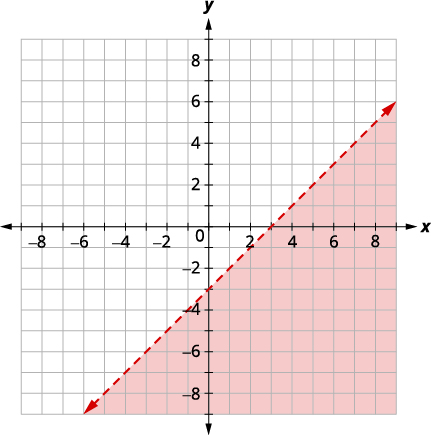
The overlapping shaded region represents all ordered pairs \((x, y)\) that satisfy both inequalities at once.
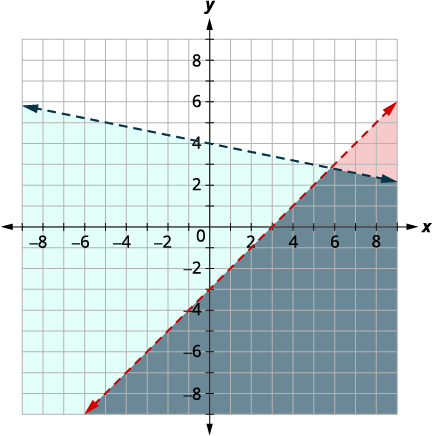
Verification: Test the point \((5, -1)\):
- \(5 - (-1) = 6 > 3\) ✓
- \(-1 < -\frac{1}{5}(5) + 4 = 3\) ✓
Both hold, confirming this point lies in the feasible region.
Notice that both boundary lines are dashed. This means points on either line are not part of the solution — only the interior of the overlapping region counts.
Source: OpenStax Intermediate Algebra 2e, Section 4.7
Solve the system by graphing:
\[x - 2y < 5\] \[y > -4\]Example 0.1.17 Solution
- Rewrite the first inequality: \(y > \frac{1}{2}x - \frac{5}{2}\). Graph the dashed boundary line \(y = \frac{1}{2}x - \frac{5}{2}\) and shade above it.
- Graph the horizontal dashed boundary line \(y = -4\) and shade above it.
- The feasible region is the overlap — the area above both boundary lines.
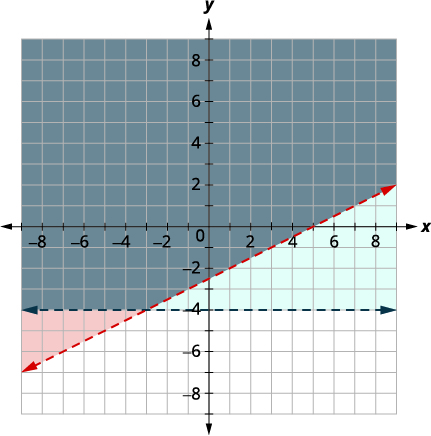
This system produces an unbounded feasible region: it extends upward and to the left without limit. There is no finite polygon enclosing the solution set.
A horizontal or vertical boundary line often signals an unbounded region, because one constraint restricts movement in only one direction while the other direction remains open.
Source: OpenStax Intermediate Algebra 2e, Section 4.7
Solve the system by graphing:
\[4x + 3y \geq 12\] \[y < -\frac{4}{3}x + 1\]Example 0.1.18 Solution
- Rewrite the first inequality: \(y \geq -\frac{4}{3}x + 4\). Graph the solid boundary line \(y = -\frac{4}{3}x + 4\) and shade above it.
- Graph the dashed boundary line \(y = -\frac{4}{3}x + 1\) and shade below it.
- Both boundary lines have the same slope \(\left(-\frac{4}{3}\right)\) but different \(y\)-intercepts — they are parallel.
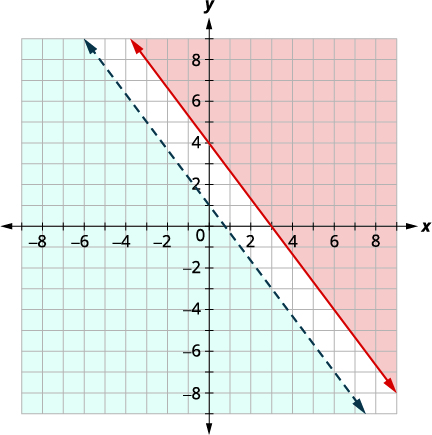
Because the shaded regions point in opposite directions and the boundary lines never intersect, there is no overlap. This system has no solution — the feasible region is empty.
When you see parallel boundary lines, pause and check which direction each shading goes. If they shade toward each other, there is overlap. If they shade away from each other, the system has no solution. It is like two people walking in opposite directions on parallel streets — they will never meet.
Key Takeaway: Parallel Boundaries
When boundary lines are parallel (same slope, different intercepts):
- No solution if the shaded half-planes face away from each other.
- Infinitely many solutions if the shaded half-planes face the same direction with overlap.
Source: OpenStax Intermediate Algebra 2e, Section 4.7
Solve the system by graphing:
\[y > \frac{1}{2}x - 4\] \[x - 2y < -4\]Example 0.1.19 Solution
- Graph the dashed boundary line \(y = \frac{1}{2}x - 4\) and shade above it.
- Rewrite the second inequality: \(y > \frac{1}{2}x + 2\). Graph the dashed boundary line \(y = \frac{1}{2}x + 2\) and shade above it.
- Both boundaries have slope \(\frac{1}{2}\), so they are parallel. But this time, both shaded half-planes point in the same direction (upward).
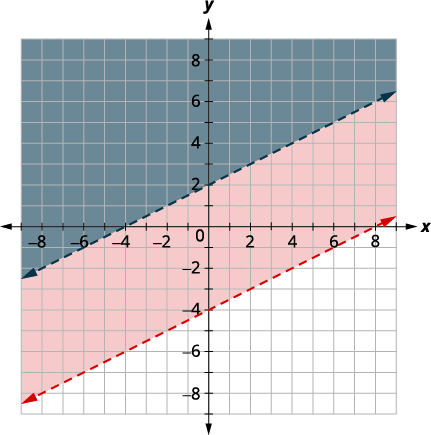
The feasible region is the area above the higher boundary line (\(y = \frac{1}{2}x + 2\)). Every point satisfying the more restrictive constraint automatically satisfies the less restrictive one as well. This feasible region is unbounded — it extends infinitely upward.
When parallel boundaries shade the same direction, the more restrictive inequality determines the boundary of the feasible region. The less restrictive one is automatically satisfied — it is redundant, like saying "you must be at least 18 and at least 16 to enter." The age-16 condition adds nothing new.
Source: OpenStax Intermediate Algebra 2e, Section 4.7
A vendor wants to display at least 25 items at a fair. Small items cost $4 each and large items cost $10 each. The vendor's budget is at most $200. Let \(x\) = number of small items and \(y\) = number of large items. Write the system of inequalities and determine whether \((20, 10)\) is feasible.
Example 0.1.20 Solution
The constraints translate to:
\[x + y \geq 25 \quad \text{(at least 25 items)}\] \[4x + 10y \leq 200 \quad \text{(budget limit)}\] \[x \geq 0, \quad y \geq 0 \quad \text{(cannot have negative quantities)}\]This system of four inequalities defines a bounded feasible region — a polygon in the first quadrant. Every point \((x, y)\) inside this region represents a combination of small and large items that meets both the minimum quantity and the budget constraint.
To check whether \((20, 10)\) is feasible:
- \(20 + 10 = 30 \geq 25\) ✓
- \(4(20) + 10(10) = 180 \leq 200\) ✓
Yes, displaying 20 small and 10 large items works within both constraints.
This is exactly the kind of problem you will solve in linear programming (Chapter 3). There, you will not just ask "is this point feasible?" — you will ask "which feasible point gives the best result?" For example, which combination of items maximizes the vendor's profit? The system of inequalities defines where you can operate; the objective function tells you where you should operate.
Try It Now 0.1.4
Source: OpenStax Intermediate Algebra 2e, Section 4.7
A bakery makes cupcakes (\(x\)) and cookies (\(y\)). They need to make at least 50 items total, each cupcake uses 3 oz of flour and each cookie uses 1 oz, and they have at most 120 oz of flour. Write the system of inequalities (do not forget non-negativity constraints).
Solution
Bounded vs. Unbounded Feasible Regions
| Property | Bounded Region | Unbounded Region |
|---|---|---|
| Shape | Closed polygon (triangle, quadrilateral, etc.) | Open region extending to infinity |
| Typical cause | Constraints form a "cage" around the solution | Constraints only restrict from some directions |
| Example | Budget + minimum quantity (Example 0.1.20) | Two inequalities shading the same direction (Example 0.1.17) |
| Finite area? | Yes | No |
| Relevance to LP | Most linear programming problems have bounded regions | Some LP problems are unbounded (no optimal solution exists) |
A bounded feasible region always has a finite number of corner points (vertices) — the points where boundary lines intersect along the edge of the region. These corner points become essential in Chapter 3, where you will evaluate an objective function at each one to find the optimal solution.
A helpful mental image: bounded regions are like fenced-in yards — you can walk around the entire perimeter. Unbounded regions are like open fields that stretch to the horizon in at least one direction. In linear programming (Chapter 3), bounded regions are the "nice" case where optimal solutions always exist.
Try It Now 0.1.5
Source: OpenStax Intermediate Algebra 2e, Section 4.7
Classify each system as producing a bounded or unbounded feasible region (no graphing needed — just reason about the constraints):
(a) \(x \geq 0\), \(y \geq 0\), \(x + y \leq 10\)
(b) \(y > 2x - 1\), \(y > -x + 3\)
Solution
(a) Bounded. The three constraints box in the feasible region: \(x \geq 0\) keeps you right of the \(y\)-axis, \(y \geq 0\) keeps you above the \(x\)-axis, and \(x + y \leq 10\) caps it with a diagonal line. This forms a triangle.
(b) Unbounded. Both inequalities shade above their boundary lines. The overlap extends upward to infinity with no constraint capping it from above.
Source: OpenStax Intermediate Algebra 2e, Section 4.7
The corner points (or vertices) of a feasible region are the points where two or more boundary lines meet at the edge of the region. These points are critically important because:
- They define the shape of a bounded feasible region.
- You find them by solving pairs of boundary-line equations simultaneously (using the methods from the Systems of Linear Equations sections).
- In optimization problems, optimal values always occur at corner points — this is the Corner Point Theorem, which you will use extensively in Chapter 3.
Why do corner points matter so much? Imagine you are trying to find the highest point in a fenced-in yard. You do not need to check every blade of grass — the highest point has to be at one of the fence corners. The Corner Point Theorem says the same thing: when optimizing a linear function over a polygon-shaped feasible region, just check the corners. This transforms a problem with infinitely many possibilities into one with just a handful of points to test.
Feasible Region Terminology
The region of the coordinate plane satisfying all constraints is called the feasible region or solution region. When it is completely enclosed, it is bounded; otherwise it is unbounded. The points where boundary lines intersect at the edge of the region are called corner points or vertices. These are the candidates you test when optimizing in linear programming (Chapter 3).
Try It Now 0.1.6
Source: OpenStax Intermediate Algebra 2e, Section 4.7
The feasible region for a system is a triangle with corner points at \((0, 0)\), \((6, 0)\), and \((0, 4)\). If you wanted to maximize \(P = 5x + 8y\) over this region, which corner point gives the largest value of \(P\)?
Solution
Evaluate \(P = 5x + 8y\) at each corner point:
- At \((0, 0)\): \(P = 5(0) + 8(0) = 0\)
- At \((6, 0)\): \(P = 5(6) + 8(0) = 30\)
- At \((0, 4)\): \(P = 5(0) + 8(4) = 32\)
The maximum value is \(P = 32\) at the corner point \((0, 4)\). This is a preview of how the Corner Point Theorem works in linear programming (Chapter 3).
Connection to Linear Programming
The feasible region from systems of inequalities is the foundation of linear programming (Chapter 3 in this course). In linear programming, you optimize an objective function (such as maximizing profit or minimizing cost) subject to a system of linear inequality constraints. The Corner Point Theorem guarantees that the optimal solution occurs at one of the corner points of the feasible region — a powerful result that makes solving these optimization problems systematic and efficient.
Everything you have learned in this section — graphing inequalities, finding feasible regions, identifying corner points — is directly applied in Chapter 3. Master these skills now, and linear programming will feel like a natural next step.
Section 0.1 Problem Set: Graphing Inequalities
Source: Applied Finite Math
This problem set practices graphing and solving inequalities in one and two variables, as well as systems of inequalities. These skills are essential for optimization problems and linear programming later in the course.
Problem Set 0.1
Part A: One-Variable Inequalities (Problems 1–5)
Tip: Remember to use open circles for strict inequalities (less than, greater than) and closed circles for inclusive inequalities (less than or equal to, greater than or equal to).
1. Graph \(x > 2\) on a number line and write in interval notation.
Problem 1 Solution
Step 1: Identify the boundary point and inequality type.
The inequality is \(x > 2\). The boundary point is \(x = 2\), and the symbol is \(>\) (strict).
Step 2: Determine the endpoint marker.
Since \(>\) is a strict inequality (no "equal to"), we use an open circle at \(2\) — the endpoint is not included.
Step 3: Determine the shading direction.
Since \(x > 2\) means all values greater than \(2\), we shade to the right of \(2\) on the number line.
Step 4: Write in interval notation.
The open circle means \(2\) is excluded (parenthesis), and the shading extends to positive infinity:
\[(2, \infty)\]Answer: Open circle at \(2\), shade right. Interval notation: \((2, \infty)\)
Verification: Test \(x = 3\): \(3 > 2\) ✓. Test \(x = 1\): \(1 > 2\) is false ✗. The boundary and shading are correct. ✓
2. Graph the compound inequality \(-2 < x < 1\) on a number line and write in interval notation.
Problem 2 Solution
Step 1: Identify the boundary points and inequality types.
The compound inequality is \(-2 < x < 1\). The boundary points are \(x = -2\) and \(x = 1\). Both symbols are \(<\) (strict).
Step 2: Determine the endpoint markers.
Both inequalities are strict (\(<\)), so we use open circles at both \(-2\) and \(1\) — neither endpoint is included.
Step 3: Determine the shading.
We shade the region between \(-2\) and \(1\) on the number line.
Step 4: Write in interval notation.
Both endpoints are excluded (parentheses):
\[(-2, 1)\]Answer: Open circles at \(-2\) and \(1\), shade between them. Interval notation: \((-2, 1)\)
Verification: Test \(x = 0\): \(-2 < 0 < 1\) ✓. Test \(x = 3\): \(-2 < 3 < 1 \implies 3 < 1\) is false ✗. Correct. ✓
3. Solve \(9c > 72\) and write the solution in interval notation.
Problem 3 Solution
Step 1: Isolate the variable by dividing both sides by \(9\).
Since \(9\) is positive, the inequality direction stays the same:
\[9c > 72\] \[c > \frac{72}{9}\] \[c > 8\]Step 2: Write in interval notation.
The boundary \(8\) is excluded (strict \(>\)), so we use a parenthesis:
\[(8, \infty)\]Answer: \(c > 8\), or in interval notation: \((8, \infty)\)
Verification: Test \(c = 9\): \(9(9) = 81 > 72\) ✓. Test \(c = 8\): \(9(8) = 72 > 72\) is false ✗ (boundary correctly excluded). ✓
4. Solve \(-7q \leq 42\) and write the solution in interval notation. (Be careful with the sign!)
Problem 4 Solution
Step 1: Isolate the variable by dividing both sides by \(-7\).
Since we are dividing by a negative number, we must flip the inequality sign:
\[-7q \leq 42\] \[q \geq \frac{42}{-7}\] \[q \geq -6\]Step 2: Write in interval notation.
The boundary \(-6\) is included (\(\geq\)), so we use a bracket:
\[[-6, \infty)\]Answer: \(q \geq -6\), or in interval notation: \([-6, \infty)\)
Verification: Test \(q = 0\): \(-7(0) = 0 \leq 42\) ✓. Test \(q = -6\): \(-7(-6) = 42 \leq 42\) ✓ (boundary included). Test \(q = -7\): \(-7(-7) = 49 \leq 42\) is false ✗. ✓
5. Alan is loading boxes (45 lb each) onto a pallet that supports at most 900 pounds. Write and solve an inequality to find the maximum number of boxes he can safely load.
Problem 5 Solution
Step 1: Define the variable and write the inequality.
Let \(b\) = the number of boxes. Each box weighs 45 lb and the pallet supports at most 900 lb:
\[45b \leq 900\]Step 2: Solve by dividing both sides by \(45\) (positive, so inequality stays the same):
\[b \leq \frac{900}{45}\] \[b \leq 20\]Step 3: Interpret the answer.
Since \(b\) must be a whole number, Alan can load at most 20 boxes.
Answer: \(45b \leq 900\); Alan can safely load at most 20 boxes.
Verification: \(20 \times 45 = 900 \leq 900\) ✓. \(21 \times 45 = 945 > 900\) ✗ (one more box exceeds the limit). ✓
Part B: Two-Variable Inequalities (Problems 6–10)
Tip: When graphing two-variable inequalities, first graph the boundary line (dashed for strict, solid for inclusive), then shade the appropriate half-plane.
6. Determine whether each ordered pair is a solution to \(y > x - 3\):
(a) \((0, 0)\) (b) \((4, 9)\) (c) \((-2, 1)\) (d) \((-5, -3)\) (e) \((5, 1)\)
Problem 6 Solution
To check each point, substitute the coordinates into \(y > x - 3\) and determine if the statement is true.
(a) \((0, 0)\): \(0 > 0 - 3 \implies 0 > -3\) ✓ Yes, \((0, 0)\) is a solution.
(b) \((4, 9)\): \(9 > 4 - 3 \implies 9 > 1\) ✓ Yes, \((4, 9)\) is a solution.
(c) \((-2, 1)\): \(1 > -2 - 3 \implies 1 > -5\) ✓ Yes, \((-2, 1)\) is a solution.
(d) \((-5, -3)\): \(-3 > -5 - 3 \implies -3 > -8\) ✓ Yes, \((-5, -3)\) is a solution.
(e) \((5, 1)\): \(1 > 5 - 3 \implies 1 > 2\) ✗ No, \((5, 1)\) is not a solution.
Answer: (a) Yes, (b) Yes, (c) Yes, (d) Yes, (e) No
Verification: For part (e), \(1 \not> 2\) confirms the point lies on the wrong side of the boundary line \(y = x - 3\). ✓
7. Graph the linear inequality \(y \geq \frac{5}{2}x - 4\).
Problem 7 Solution
Step 1: Identify the boundary line equation.
Boundary: \(y = \frac{5}{2}x - 4\)
Step 2: Determine solid vs. dashed line.
The inequality symbol is \(\geq\) (non-strict), so we draw a solid line — points on the line are included.
Step 3: Plot the boundary line.
- \(y\)-intercept: set \(x = 0\): \(y = -4\), giving point \((0, -4)\)
- Using slope \(\frac{5}{2}\): from \((0, -4)\), rise 5 and run 2 to get \((2, 1)\)
- Connect with a solid line.
Step 4: Choose a test point and substitute.
Test point: \((0, 0)\) (not on the boundary line)
\[0 \geq \frac{5}{2}(0) - 4 \implies 0 \geq -4 \quad \checkmark \text{ True}\]Step 5: Shade the correct half-plane.
Since \((0, 0)\) satisfies the inequality, shade the side of the line that contains \((0, 0)\) — the region above the boundary line.
Answer: Draw a solid line through \((0, -4)\) and \((2, 1)\) with slope \(\frac{5}{2}\). Shade the region above the line (containing the origin).
Verification: Test \((0, 0)\): \(0 \geq -4\) ✓. Test \((0, -5)\): \(-5 \geq -4\) is false ✗ (correctly not in shaded region). ✓
8. Graph the linear inequality \(2x - 3y < 6\).
Problem 8 Solution
Step 1: Identify the boundary line equation.
Boundary: \(2x - 3y = 6\)
Step 2: Determine solid vs. dashed line.
The inequality symbol is \(<\) (strict), so we draw a dashed line — points on the line are NOT included.
Step 3: Plot the boundary line using intercepts.
- \(x\)-intercept: set \(y = 0\): \(2x = 6 \implies x = 3\), giving point \((3, 0)\)
- \(y\)-intercept: set \(x = 0\): \(-3y = 6 \implies y = -2\), giving point \((0, -2)\)
- Connect with a dashed line.
Step 4: Choose a test point and substitute.
Test point: \((0, 0)\) (not on the boundary line)
\[2(0) - 3(0) < 6 \implies 0 < 6 \quad \checkmark \text{ True}\]Step 5: Shade the correct half-plane.
Since \((0, 0)\) satisfies the inequality, shade the side of the line that contains \((0, 0)\) — the region above the boundary line.
Answer: Draw a dashed line through \((3, 0)\) and \((0, -2)\). Shade the region above the line (containing the origin).
Verification: Test \((0, 0)\): \(0 < 6\) ✓. Test \((3, -3)\): \(2(3) - 3(-3) = 6 + 9 = 15 < 6\) is false ✗ (correctly not in shaded region). ✓
9. Graph the linear inequality \(y > -3x\). (Note: the boundary passes through the origin.)
Problem 9 Solution
Step 1: Identify the boundary line equation.
Boundary: \(y = -3x\)
Step 2: Determine solid vs. dashed line.
The inequality symbol is \(>\) (strict), so we draw a dashed line — points on the line are NOT included.
Step 3: Plot the boundary line.
- The line passes through the origin \((0, 0)\) with slope \(-3\).
- From \((0, 0)\), move right 1 and down 3 to get \((1, -3)\).
- Connect with a dashed line.
Step 4: Choose a test point and substitute.
Since the boundary passes through \((0, 0)\), we cannot use the origin. Choose \((1, 0)\) instead:
\[0 > -3(1) \implies 0 > -3 \quad \checkmark \text{ True}\]Step 5: Shade the correct half-plane.
Since \((1, 0)\) satisfies the inequality, shade the side of the line that contains \((1, 0)\) — the region above the boundary line.
Answer: Draw a dashed line through \((0, 0)\) and \((1, -3)\) with slope \(-3\). Shade the region above the line (containing the point \((1, 0)\)).
Verification: Test \((1, 0)\): \(0 > -3\) ✓. Test \((1, -4)\): \(-4 > -3\) is false ✗ (correctly not in shaded region). ✓
10. Hugh wants to earn at least $260 per week working at a grocery store ($10/hr) and babysitting ($13/hr). Write and graph the inequality. Find three ordered pairs that are solutions.
Problem 10 Solution
Step 1: Define variables and write the inequality.
Let \(x\) = hours at the grocery store ($10/hr) and \(y\) = hours babysitting ($13/hr). Hugh wants to earn at least $260:
\[10x + 13y \geq 260\]Step 2: Identify the boundary line.
Boundary: \(10x + 13y = 260\)
Step 3: Determine solid vs. dashed line.
The symbol is \(\geq\) (non-strict), so draw a solid line.
Step 4: Plot the boundary line using intercepts.
- \(x\)-intercept: set \(y = 0\): \(10x = 260 \implies x = 26\), giving \((26, 0)\)
- \(y\)-intercept: set \(x = 0\): \(13y = 260 \implies y = 20\), giving \((0, 20)\)
- Connect with a solid line.
Step 5: Choose a test point and substitute.
Test point: \((0, 0)\)
\[10(0) + 13(0) = 0 \geq 260 \quad \text{False}\]Step 6: Shade the correct half-plane.
Since \((0, 0)\) does NOT satisfy the inequality, shade the opposite side from the origin — the region above and to the right of the boundary line.
Step 7: Find three ordered pairs that are solutions.
- \((26, 0)\): \(10(26) + 13(0) = 260 \geq 260\) ✓ (all grocery store hours)
- \((0, 20)\): \(10(0) + 13(20) = 260 \geq 260\) ✓ (all babysitting hours)
- \((10, 13)\): \(10(10) + 13(13) = 100 + 169 = 269 \geq 260\) ✓ (a mix of both)
Answer: The inequality is \(10x + 13y \geq 260\). Draw a solid boundary line through \((26, 0)\) and \((0, 20)\), shade above (away from origin). Three solutions: \((26, 0)\), \((0, 20)\), and \((10, 13)\).
Verification: Test \((10, 13)\): \(10(10) + 13(13) = 100 + 169 = 269 \geq 260\) ✓
Part C: Systems of Inequalities (Problems 11–15)
Tip: The solution to a system of inequalities is the region where all shaded areas overlap.
11. Determine whether the ordered pair \((2, 3)\) is a solution to the system:
\[x + y \leq 8\] \[2x - y > 1\]Problem 11 Solution
We must check whether \((2, 3)\) satisfies both inequalities in the system.
Step 1: Check the first inequality \(x + y \leq 8\):
\[2 + 3 = 5 \leq 8 \quad \checkmark \text{ True}\]Step 2: Check the second inequality \(2x - y > 1\):
\[2(2) - 3 = 4 - 3 = 1 > 1 \quad \text{False}\]Since \(1 = 1\) is not strictly greater than \(1\), the second inequality fails.
Answer: \((2, 3)\) is not a solution to the system because it fails the second inequality (\(1 \not> 1\)).
Verification: The second inequality requires strictly greater than \(1\). Since \(2(2) - 3 = 1\) and \(1 = 1\) (not \(> 1\)), the point lies on the boundary line, which is excluded for a strict inequality. ✓
12. Solve the system by graphing:
\[y \leq 2x + 1\] \[y > -x + 4\]Problem 12 Solution
Graph the first inequality: \(y \leq 2x + 1\)
Step 1: Boundary: \(y = 2x + 1\) — solid line (because of \(\leq\)).
- \(y\)-intercept: \((0, 1)\). Slope: \(2\) (rise 2, run 1). Second point: \((1, 3)\).
Step 2: Test \((0, 0)\): \(0 \leq 2(0) + 1 = 1\). Since \(0 \leq 1\) is true, shade the side containing \((0, 0)\) — below the line.
Graph the second inequality: \(y > -x + 4\)
Step 3: Boundary: \(y = -x + 4\) — dashed line (because of \(>\)).
- \(y\)-intercept: \((0, 4)\). Slope: \(-1\). Second point: \((4, 0)\).
Step 4: Test \((0, 0)\): \(0 > -(0) + 4 = 4\). Since \(0 > 4\) is false, shade the opposite side from \((0, 0)\) — above the line.
Find the feasible region:
Step 5: Find where the boundary lines intersect:
\[2x + 1 = -x + 4 \implies 3x = 3 \implies x = 1, \quad y = 2(1) + 1 = 3\]The boundaries intersect at \((1, 3)\).
Step 6: The feasible region is the overlap: below \(y = 2x + 1\) AND above \(y = -x + 4\). This is a wedge-shaped region to the right of the intersection point \((1, 3)\), and it is unbounded (extends to the right without limit).
Answer: The feasible region is the wedge-shaped area to the right of \((1, 3)\), below the solid line \(y = 2x + 1\) and above the dashed line \(y = -x + 4\). The region is unbounded.
Verification: Test \((3, 2)\) from the overlap region: \(2 \leq 2(3) + 1 = 7\) ✓ and \(2 > -(3) + 4 = 1\) ✓. Both inequalities satisfied. ✓
13. Solve the system by graphing:
\[3x + y \geq 6\] \[x - y > 2\]Problem 13 Solution
Graph the first inequality: \(3x + y \geq 6\)
Step 1: Rewrite: \(y \geq -3x + 6\). Boundary: \(y = -3x + 6\) — solid line (because of \(\geq\)).
- \(y\)-intercept: \((0, 6)\). \(x\)-intercept: set \(y = 0\): \(3x = 6 \implies x = 2\), giving \((2, 0)\).
Step 2: Test \((0, 0)\): \(3(0) + 0 = 0 \geq 6\). Since \(0 \geq 6\) is false, shade the opposite side from \((0, 0)\) — above the line (the side away from the origin).
Graph the second inequality: \(x - y > 2\)
Step 3: Rewrite: \(y < x - 2\). Boundary: \(y = x - 2\) — dashed line (because \(>\) becomes \(<\) when solving for \(y\)).
- \(y\)-intercept: \((0, -2)\). \(x\)-intercept: set \(y = 0\): \(x = 2\), giving \((2, 0)\).
Step 4: Test \((0, 0)\): \(0 - 0 = 0 > 2\). Since \(0 > 2\) is false, shade the opposite side from \((0, 0)\) — below the line.
Find the feasible region:
Step 5: Find where the boundary lines intersect:
\[-3x + 6 = x - 2 \implies -4x = -8 \implies x = 2, \quad y = 2 - 2 = 0\]The boundaries intersect at \((2, 0)\).
Step 6: The feasible region is the overlap: above \(y = -3x + 6\) AND below \(y = x - 2\). This is a wedge-shaped region to the right of \((2, 0)\). The region is unbounded (extends to the right without limit).
Answer: The feasible region is the wedge-shaped area to the right of \((2, 0)\), above the solid line \(3x + y = 6\) and below the dashed line \(x - y = 2\). The region is unbounded.
Verification: Test \((4, -3)\) from the overlap region: \(3(4) + (-3) = 9 \geq 6\) ✓ and \(4 - (-3) = 7 > 2\) ✓. Both inequalities satisfied. ✓
14. Solve the system by graphing and determine whether the feasible region is bounded or unbounded:
\[y \geq x - 1\] \[y \leq x + 3\]Problem 14 Solution
Graph the first inequality: \(y \geq x - 1\)
Step 1: Boundary: \(y = x - 1\) — solid line (because of \(\geq\)).
- \(y\)-intercept: \((0, -1)\). Slope: \(1\). Second point: \((1, 0)\).
Step 2: Test \((0, 0)\): \(0 \geq 0 - 1 = -1\). Since \(0 \geq -1\) is true, shade the side containing \((0, 0)\) — above the line.
Graph the second inequality: \(y \leq x + 3\)
Step 3: Boundary: \(y = x + 3\) — solid line (because of \(\leq\)).
- \(y\)-intercept: \((0, 3)\). Slope: \(1\). Second point: \((1, 4)\).
Step 4: Test \((0, 0)\): \(0 \leq 0 + 3 = 3\). Since \(0 \leq 3\) is true, shade the side containing \((0, 0)\) — below the line.
Find the feasible region:
Step 5: Both boundary lines have slope \(1\), so they are parallel (they never intersect). The line \(y = x + 3\) is 4 units above \(y = x - 1\).
Step 6: The feasible region is the band/strip between the two parallel lines: above \(y = x - 1\) and below \(y = x + 3\). Both boundaries are solid (included).
Step 7: Determine bounded or unbounded.
The region is unbounded — it forms an infinite diagonal strip that extends forever to the left and to the right. There is no finite polygon enclosing it.
Answer: The feasible region is the infinite diagonal strip between the solid lines \(y = x - 1\) and \(y = x + 3\) (both boundaries included). The region is unbounded.
Verification: Test \((0, 0)\): \(0 \geq 0 - 1 = -1\) ✓ and \(0 \leq 0 + 3 = 3\) ✓. The point \((0, 0)\) lies within the strip. ✓
15. A bakery makes small cakes (\(x\)) and large cakes (\(y\)). They need to make at least 20 cakes total and can spend at most $150 on ingredients. Small cakes cost $5 each and large cakes cost $10 each. Write the system of inequalities (include non-negativity constraints) and determine whether \((15, 8)\) is a feasible solution.
Problem 15 Solution
Step 1: Define variables and translate constraints into inequalities.
Let \(x\) = number of small cakes and \(y\) = number of large cakes.
- At least 20 cakes total: \(x + y \geq 20\)
- Budget at most $150: \(5x + 10y \leq 150\)
- Non-negativity: \(x \geq 0\) and \(y \geq 0\)
Step 2: Write the complete system of inequalities:
\[x + y \geq 20\] \[5x + 10y \leq 150\] \[x \geq 0\] \[y \geq 0\]Step 3: Check whether \((15, 8)\) is a feasible solution by substituting into every inequality.
- \(x + y \geq 20\): \(15 + 8 = 23 \geq 20\) ✓
- \(5x + 10y \leq 150\): \(5(15) + 10(8) = 75 + 80 = 155 \leq 150\) ✗
- \(x \geq 0\): \(15 \geq 0\) ✓
- \(y \geq 0\): \(8 \geq 0\) ✓
Step 4: Determine feasibility.
The point \((15, 8)\) fails the budget constraint ($155 > $150), so it is not a feasible solution.
Answer: The system is: \(x + y \geq 20\), \(5x + 10y \leq 150\), \(x \geq 0\), \(y \geq 0\). The point \((15, 8)\) is not feasible because \(5(15) + 10(8) = 155 > 150\) exceeds the budget.
Verification: \(75 + 80 = 155 > 150\) confirms the budget constraint is violated. ✓