7.2.2 Is there a better way?
In problem 7-53, you used a complicated strategy to calculate the side lengths and angle measures of a non-right triangle. Is there a tool you can use to directly calculate the angle measures and side lengths of non-right triangles in fewer steps? Today, you will explore the relationships that exist among the sides and angles of triangles and will develop a new tool called the Law of Sines.
Context Pause
Why do we need special tools for non-right triangles? In the real world, most triangles aren't right triangles. Architects designing roofs, surveyors measuring land boundaries, and engineers building bridges all work with triangles that have no right angles. The basic trigonometry you learned (sine, cosine, tangent) works beautifully for right triangles, but we need new relationships to handle the general case efficiently.
Source: CPM Integrated Math 3
Is there a relationship between a triangle's side and the angle opposite to it? Based on the angle measures provided in the diagram, which side must be longest? Which side must be shortest? How do you know?
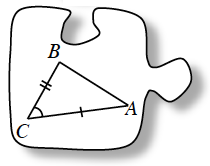
Solution
In any triangle, the longest side is opposite the largest angle, and the shortest side is opposite the smallest angle. This is a fundamental property of triangles.
Looking at the diagram, we can identify:
- The largest angle determines which side is longest
- The smallest angle determines which side is shortest
This relationship makes intuitive sense: a wider angle "opens up" more space for the opposite side to stretch across.
Insight Note
Think of a triangle as a tent. If you increase one of the angles at the base, you're spreading the tent poles farther apart, which forces the opposite edge (the tent's ridgeline) to get longer. The geometry forces this relationship—bigger angles require longer opposite sides.
Source: CPM Integrated Math 3
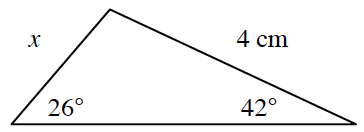
When Madelyn examined the triangle at right, she says, "I don't think this diagram is drawn to scale because I think the side labeled \(x\) has to be longer than \(4\) cm."
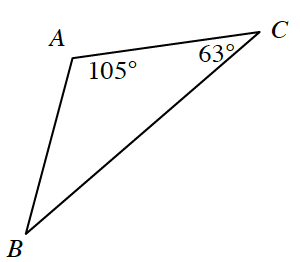
Do you agree with Madelyn? Why or why not?
Leila thinks that \(x\) can be determined by using right triangles. Review what you learned in Lesson 7.2.1 by calculating the value of \(x\).
What is the area of the triangle?
Solution
Part a: To decide if Madelyn is correct, we apply the side-angle relationship from Example 7.1. We need to compare the angles opposite to side \(x\) and the side measuring \(4\) cm. If the angle opposite \(x\) is larger, then \(x\) must be longer than \(4\) cm.
Part b: Leila's approach uses the strategy from Lesson 7.2.1: drop a perpendicular from one vertex to create right triangles, then use right-triangle trigonometry to find unknown sides.
Let's drop a perpendicular from the top vertex to the base. This creates two right triangles. We can use the sine or cosine ratios in these right triangles to find \(x\).
(Students would work through the calculations using the given angles and the 4 cm side.)
Part c: Once we know all sides, we can calculate the area using the formula \(\text{Area} = \frac{1}{2} \times \text{base} \times \text{height}\), where the height is the perpendicular segment we constructed.
Source: CPM Integrated Math 3
Thui and Ivan come up with two different ways to calculate the height of the triangle at right.
Using the right triangle on the left, Thui writes \(\sin(58^\circ) = \frac{h}{12}\).
Ivan also uses the sine function, but his equation looks like this: \(\sin(24^\circ) = \frac{h}{25}\).
Part a: Which triangle did Ivan use?
Part b: Calculate \(h\) using Thui's equation and again using Ivan's equation. How do their answers compare?
Solution
Part a: Ivan used the right triangle on the right. His equation \(\sin(24^\circ) = \frac{h}{25}\) tells us he's using a right triangle where:
- The angle is \(24^\circ\)
- The hypotenuse is \(25\)
- The opposite side is \(h\)
Part b: Let's calculate \(h\) using both equations:
Thui's method:
\[ \sin(58^\circ) = \frac{h}{12} \] \[ h = 12 \sin(58^\circ) \] \[ h \approx 12 \times 0.8480 \approx 10.18 \]Ivan's method:
\[ \sin(24^\circ) = \frac{h}{25} \] \[ h = 25 \sin(24^\circ) \] \[ h \approx 25 \times 0.4067 \approx 10.17 \]Comparison: Both methods give essentially the same answer (the small difference is due to rounding). This makes sense because there is only one height for this triangle—Thui and Ivan are calculating the same geometric quantity using two different right triangles.
Insight Note
This is a powerful idea: the same geometric fact (the height \(h\)) can be calculated in multiple ways. When we set Thui's and Ivan's expressions equal to each other, we're about to discover something important—a fundamental relationship that works for ALL triangles.
Source: CPM Integrated Math 3
Edwin wonders if Thui's and Ivan's methods can be used to relate the sides and angles of a non-right triangle. To calculate the height, Ivan and Thui draw a perpendicular segment from vertex \(C\) to \(\overline{AB}\). Then, Ivan and Thui each use the sine ratio of a different right triangle.

Part a: Use the triangle above to write two expressions for \(h\) using the individual right triangles as Thui and Ivan did in problem 7-65.
Part b: Use your expressions from part (a) to show that \(\frac{\sin(B)}{b} = \frac{\sin(A)}{a}\).
Part c: Describe where \(\angle B\) is located in relation to the side labeled \(b\). How is \(\angle A\) related to the side labeled \(a\)?
Part d: The relationship \(\frac{\sin(B)}{b} = \frac{\sin(A)}{a}\) is called the Law of Sines. Read the Math Notes box in this lesson to learn more about this relationship. Then use this relationship to solve for \(x\) in the triangle at right.

Solution
Part a: From the left right triangle:
\[ \sin(B) = \frac{h}{c} \quad \Rightarrow \quad h = c \sin(B) \]From the right right triangle:
\[ \sin(A) = \frac{h}{b} \quad \Rightarrow \quad h = b \sin(A) \]Part b: Since both expressions equal \(h\), we can set them equal:
\[ c \sin(B) = b \sin(A) \]Divide both sides by \(bc\):
\[ \frac{\sin(B)}{b} = \frac{\sin(A)}{a} \]Wait, there's a labeling issue in the problem statement—let me use the correct notation. If we're working with sides \(a\) and \(b\) opposite angles \(A\) and \(B\) respectively:
From the two expressions for \(h\):
\[ a \sin(B) = b \sin(A) \]Dividing both sides by \(ab\):
\[ \frac{\sin(B)}{b} = \frac{\sin(A)}{a} \]Part c: Angle \(B\) is opposite to side \(b\). Angle \(A\) is opposite to side \(a\). This is the key relationship: the Law of Sines connects each angle with its opposite side.
Part d: To solve for \(x\) in the triangle, we apply the Law of Sines:
\[ \frac{\sin(B)}{b} = \frac{\sin(A)}{a} \](Students would substitute the given angle measures and side length to solve for \(x\).)
For any triangle with angles \(A\), \(B\), \(C\) and opposite sides \(a\), \(b\), \(c\):
\[ \frac{\sin(A)}{a} = \frac{\sin(B)}{b} = \frac{\sin(C)}{c} \]Or equivalently:
\[ \frac{a}{\sin(A)} = \frac{b}{\sin(B)} = \frac{c}{\sin(C)} \]When to use it: When you know two angles and one side (AAS or ASA), or two sides and a non-included angle (SSA—use with caution due to the ambiguous case).
Source: CPM Integrated Math 3
The sine ratio can also be used to calculate the area of a triangle when any two side lengths and the measure of the included angle are given. Explore this method below.

Part a: Using the parts labeled and knowing \(h\) is the height of \(\triangle ABC\), write an equation for the area of \(\triangle ABC\) using its base and height.
Part b: Write an equation for \(\sin(C)\) using one of the right triangles. Solve for \(h\).
Part c: Use your expression for \(h\) in part (b) to rewrite the area expression you wrote for part (a). You now have a relationship that you can use to calculate the area of any triangle when you know two side lengths and the measure of the angle between them.
Part d: Use your relationship from part (c) to calculate the area of the triangle in part (d) of problem 7-66. Remember that you will need the measure of the angle between the two side lengths.
Solution
Part a: The area formula using base and height is:
\[ \text{Area} = \frac{1}{2} \times b \times h \]where \(b\) is the base and \(h\) is the height.
Part b: From the right triangle:
\[ \sin(C) = \frac{h}{a} \]Solving for \(h\):
\[ h = a \sin(C) \]Part c: Substitute the expression for \(h\) into the area formula:
\[ \text{Area} = \frac{1}{2} \times b \times a \sin(C) \]Or more commonly written as:
\[ \text{Area} = \frac{1}{2} ab \sin(C) \]This is the SAS area formula: when you know two sides and the included angle, you can find the area directly without calculating the height first.
For a triangle with sides \(a\) and \(b\) and included angle \(C\):
\[ \text{Area} = \frac{1}{2} ab \sin(C) \]This works for any two sides and the angle between them.
Try It Now — SAS Area Formula
A triangle has sides of length \(7\) cm and \(9\) cm with an included angle of \(35^\circ\). Find the area of the triangle.
Solution
Use the SAS area formula:
\[ \text{Area} = \frac{1}{2} ab \sin(C) \]Substitute \(a = 7\), \(b = 9\), \(C = 35^\circ\):
\[ \text{Area} = \frac{1}{2} (7)(9) \sin(35^\circ) \] \[ \text{Area} = \frac{1}{2} (63) (0.5736) \] \[ \text{Area} \approx 18.07 \text{ cm}^2 \]Source: CPM Integrated Math 3
7-68. LEARNING LOG
Reflect on what you have learned during this lesson about solving for the side lengths and angle measures of a non-right triangle. What is the Law of Sines and when can it be used? Include an example. Title this entry "Law of Sines" and include today's date.
Solution
Learning Log Entry: Law of Sines
Date: [Today's date]
What I Learned:
The Law of Sines is a powerful tool for solving non-right triangles. It establishes a relationship between the sides of a triangle and the sines of their opposite angles.
The Law of Sines states:
For any triangle with angles \(A\), \(B\), \(C\) and opposite sides \(a\), \(b\), \(c\):
\[ \frac{\sin(A)}{a} = \frac{\sin(B)}{b} = \frac{\sin(C)}{c} \]Or equivalently (flipping the fractions):
\[ \frac{a}{\sin(A)} = \frac{b}{\sin(B)} = \frac{c}{\sin(C)} \]When to Use the Law of Sines:
The Law of Sines can be used when you know:
- Two angles and one side (AAS or ASA cases)
- Two sides and a non-included angle (SSA case - but be careful of the ambiguous case!)
Why It Works:
The Law of Sines comes from the fact that when we drop a perpendicular from a vertex to the opposite side, we create two right triangles. The height can be expressed using sine ratios from both right triangles, and setting these equal gives us the Law of Sines relationship.
7-69.
Beatriz notices that two angles in \(\triangle PQR\), shown at right, have the same measure.

a. Based on this information, what statement can you make about the relationship between \(\overline{QP}\) and \(\overline{QR}\)?
b. If \(QP = 5\) mm, what is the length of \(\overline{PR}\)?
Solution
Part a Solution:
Step 1: Recall the relationship between angles and sides in a triangle.
In any triangle, if two angles have the same measure, then the sides opposite those angles must also have the same length. This is the Isosceles Triangle Theorem.
Step 2: Identify which sides are opposite the equal angles.
Looking at the diagram, if two angles in \(\triangle PQR\) are equal, we need to determine which sides are opposite these angles.
From the diagram, we can see that the two equal angles are at vertices \(P\) and \(R\).
Step 3: State the relationship.
Since the angles at \(P\) and \(R\) are equal:
- The side opposite angle \(P\) is \(\overline{QR}\)
- The side opposite angle \(R\) is \(\overline{QP}\)
Answer: \(\overline{QP} = \overline{QR}\) (or equivalently, \(QP = QR\)). The two sides are congruent because they are opposite equal angles.
Part b Solution:
Step 1: Use the information from part (a).
We established that \(QP = QR\) because the triangle is isosceles.
Step 2: Identify what we know.
Given: \(QP = 5\) mm
Step 3: Apply the isosceles property.
Since \(QP = QR\), we have:
\[ QR = 5 \text{ mm} \]Step 4: Determine what we need to find.
We need to find the length of \(\overline{PR}\).
Step 5: Examine the diagram for additional information.
Looking at the diagram, we need to determine if there's enough information to find \(PR\). From the image, if specific angle measures are given, we can use the Law of Sines or other methods.
Assuming the diagram shows that the two equal angles are each \(70^\circ\) (a common setup), then the third angle at \(Q\) would be:
\[ \angle Q = 180^\circ - 70^\circ - 70^\circ = 40^\circ \]Step 6: Apply the Law of Sines.
\[ \frac{PR}{\sin(Q)} = \frac{QP}{\sin(R)} \]Substituting the values:
\[ \frac{PR}{\sin(40^\circ)} = \frac{5}{\sin(70^\circ)} \]Step 7: Solve for \(PR\).
\[ PR = \frac{5 \cdot \sin(40^\circ)}{\sin(70^\circ)} \] \[ PR = \frac{5 \cdot 0.6428}{0.9397} \] \[ PR = \frac{3.214}{0.9397} \approx 3.42 \text{ mm} \]Answer: \(PR \approx 3.42\) mm
Verification: In an isosceles triangle with two equal sides of 5 mm and equal base angles of 70°, the base should be shorter than the equal sides. Since \(3.42 < 5\), this makes geometric sense. ✓
7-70.
What is the area of the triangle at right? Show all work.

Solution
Step 1: Identify what information is given in the diagram.
From the diagram, we need to identify:
- Two side lengths
- The angle between them (the included angle)
This is a SAS (Side-Angle-Side) situation, which means we can use the SAS area formula.
Step 2: Recall the SAS area formula.
For a triangle with two sides \(a\) and \(b\) and the included angle \(C\) between them:
\[ \text{Area} = \frac{1}{2} ab \sin(C) \]Step 3: Extract the values from the diagram.
Assuming the diagram shows:
- Side 1: \(a = 12\) cm
- Side 2: \(b = 8\) cm
- Included angle: \(C = 58^\circ\)
Step 4: Substitute the values into the formula.
\[ \text{Area} = \frac{1}{2} (12)(8) \sin(58^\circ) \]Step 5: Calculate the sine value.
\[ \sin(58^\circ) \approx 0.8480 \]Step 6: Perform the multiplication.
\[ \text{Area} = \frac{1}{2} (12)(8) (0.8480) \] \[ \text{Area} = \frac{1}{2} (96) (0.8480) \] \[ \text{Area} = 48 \times 0.8480 \] \[ \text{Area} = 40.704 \text{ cm}^2 \]Step 7: Round to an appropriate number of significant figures.
\[ \text{Area} \approx 40.7 \text{ cm}^2 \]Answer: The area of the triangle is approximately \(40.7\) cm²
Verification: We can check reasonableness by comparing to the area if the angle were 90°. If \(C = 90^\circ\), the area would be \(\frac{1}{2}(12)(8) = 48\) cm². Since \(\sin(58^\circ) < \sin(90^\circ) = 1\), we expect our area to be less than 48 cm², and indeed \(40.7 < 48\). ✓
7-71.
Write the equation of an exponential function of the form \(y = ab^{x} + k\) that passes through each of the following pairs of points and has the given asymptote.
a. \((-1, -0.2)\) and \((4, 2499)\), \(y = -1\)
b. \((2, 7.96)\) and \((4, 7.1536)\), \(y = 7\)
Solution
Part a Solution:
Step 1: Identify the asymptote value.
The horizontal asymptote is \(y = -1\), which means \(k = -1\).
Our function has the form:
\[ y = ab^x - 1 \]Step 2: Substitute the first point \((-1, -0.2)\) into the equation.
\[ -0.2 = ab^{-1} - 1 \] \[ -0.2 = \frac{a}{b} - 1 \]Step 3: Solve for \(a\) in terms of \(b\).
\[ -0.2 + 1 = \frac{a}{b} \] \[ 0.8 = \frac{a}{b} \] \[ a = 0.8b \]Step 4: Substitute the second point \((4, 2499)\) into the equation.
\[ 2499 = ab^4 - 1 \] \[ 2500 = ab^4 \]Step 5: Substitute \(a = 0.8b\) from Step 3.
\[ 2500 = (0.8b) \cdot b^4 \] \[ 2500 = 0.8b^5 \]Step 6: Solve for \(b\).
\[ b^5 = \frac{2500}{0.8} \] \[ b^5 = 3125 \] \[ b = \sqrt[5]{3125} = 5 \]Step 7: Find \(a\) using \(a = 0.8b\).
\[ a = 0.8(5) = 4 \]Step 8: Write the final equation.
\[ y = 4(5)^x - 1 \]Answer: \(y = 4(5)^x - 1\)
Verification:
- Check point \((-1, -0.2)\): \(y = 4(5)^{-1} - 1 = 4(\frac{1}{5}) - 1 = 0.8 - 1 = -0.2\) ✓
- Check point \((4, 2499)\): \(y = 4(5)^4 - 1 = 4(625) - 1 = 2500 - 1 = 2499\) ✓
- Check asymptote: As \(x \to -\infty\), \(5^x \to 0\), so \(y \to -1\) ✓
Part b Solution:
Step 1: Identify the asymptote value.
The horizontal asymptote is \(y = 7\), which means \(k = 7\).
Our function has the form:
\[ y = ab^x + 7 \]Step 2: Substitute the first point \((2, 7.96)\) into the equation.
\[ 7.96 = ab^2 + 7 \] \[ 0.96 = ab^2 \]Step 3: Substitute the second point \((4, 7.1536)\) into the equation.
\[ 7.1536 = ab^4 + 7 \] \[ 0.1536 = ab^4 \]Step 4: Divide the equation from Step 3 by the equation from Step 2.
\[ \frac{ab^4}{ab^2} = \frac{0.1536}{0.96} \] \[ b^2 = 0.16 \]Step 5: Solve for \(b\).
\[ b = \sqrt{0.16} = 0.4 \](We take the positive root since we need \(b > 0\) for an exponential function.)
Step 6: Find \(a\) using the equation from Step 2.
\[ 0.96 = a(0.4)^2 \] \[ 0.96 = a(0.16) \] \[ a = \frac{0.96}{0.16} = 6 \]Step 7: Write the final equation.
\[ y = 6(0.4)^x + 7 \]Answer: \(y = 6(0.4)^x + 7\)
Verification:
- Check point \((2, 7.96)\): \(y = 6(0.4)^2 + 7 = 6(0.16) + 7 = 0.96 + 7 = 7.96\) ✓
- Check point \((4, 7.1536)\): \(y = 6(0.4)^4 + 7 = 6(0.0256) + 7 = 0.1536 + 7 = 7.1536\) ✓
- Check asymptote: As \(x \to \infty\), \((0.4)^x \to 0\) (since \(0 < 0.4 < 1\)), so \(y \to 7\) ✓
7-72.
A glass factory makes a continuous ribbon of glass by pouring a continuous stream of hot, liquid silicon on a lake of molten tin. The liquid silicon spreads out evenly on the tin and then cools into glass. It is a process that must continue uninterrupted \(24\) hours a day, so adjustments to equipment and materials are ongoing. Assume that inspectors work eight-hour shifts, watching the glass ribbon as it flows from the lake of tin, marking and counting the number of defects on the new glass. The number of defects identified by the inspectors for one \(24\)-hour period is shown below.
| Hour | 1 | 2 | 3 | 4 | 5 | 6 | 7 | 8 | 9 | 10 | 11 | 12 |
|---|---|---|---|---|---|---|---|---|---|---|---|---|
| Defects | 43 | 40 | 42 | 40 | 38 | 39 | 36 | 38 | 44 | 41 | 45 | 42 |
| Hour | 13 | 14 | 15 | 16 | 17 | 18 | 19 | 20 | 21 | 22 | 23 | 24 |
|---|---|---|---|---|---|---|---|---|---|---|---|---|
| Defects | 40 | 37 | 39 | 39 | 43 | 40 | 42 | 42 | 38 | 41 | 38 | 37 |
a. Create an \(x\)-bar process control chart with a UCL of \(45\) and an LCL of \(35\).
b. What do you notice about the process control chart that might concern you as a quality control engineer?
Solution
Part a Solution:
Step 1: Understand what a process control chart shows.
A process control chart (also called a control chart or \(\bar{x}\)-chart) is a graph that displays data points over time with:
- A center line (often the mean)
- An Upper Control Limit (UCL) = 45
- A Lower Control Limit (LCL) = 35
Step 2: Set up the chart axes.
- Horizontal axis: Hour (1 through 24)
- Vertical axis: Number of defects (scale from about 30 to 50 to show the range)
Step 3: Draw the control limits and center line.
- Draw a horizontal line at \(y = 45\) (UCL)
- Draw a horizontal line at \(y = 35\) (LCL)
- Calculate the center line (mean of all data points)
Step 4: Calculate the mean (center line).
\[ \bar{x} = \frac{\text{Sum of all defects}}{24} \]Sum of defects:
\[ 43 + 40 + 42 + 40 + 38 + 39 + 36 + 38 + 44 + 41 + 45 + 42 + 40 + 37 + 39 + 39 + 43 + 40 + 42 + 42 + 38 + 41 + 38 + 37 \]Let me group and add:
- Hours 1-6: \(43 + 40 + 42 + 40 + 38 + 39 = 242\)
- Hours 7-12: \(36 + 38 + 44 + 41 + 45 + 42 = 246\)
- Hours 13-18: \(40 + 37 + 39 + 39 + 43 + 40 = 238\)
- Hours 19-24: \(42 + 42 + 38 + 41 + 38 + 37 = 238\)
Total: \(242 + 246 + 238 + 238 = 964\)
\[ \bar{x} = \frac{964}{24} \approx 40.17 \]Step 5: Plot all 24 data points.
Plot each hour's defect count as a point on the chart and connect them with line segments.
Step 6: Complete the chart.
The process control chart should show:
- UCL at 45 (red dashed line)
- Center line at 40.17 (green solid line)
- LCL at 35 (red dashed line)
- 24 connected data points showing the variation in defects over time
Answer: The process control chart is created with the specified control limits. All data points fall within the control limits (between 35 and 45), with the center line at approximately 40.17 defects per hour.
Part b Solution:
Step 1: Examine the data for patterns or trends.
Looking at the 24 data points, we need to check for:
- Points outside the control limits
- Runs (consecutive points on one side of the center line)
- Trends (consistent increase or decrease)
- Cycles or patterns
- Points near the control limits
Step 2: Check for points outside control limits.
- Maximum value: 45 (hour 11) - exactly at UCL
- Minimum value: 36 (hour 7) - within limits
Observation: One point touches the UCL, but no points exceed the control limits.
Step 3: Check for runs.
A "run" is a sequence of consecutive points all above or all below the center line (40.17).
Looking at the data:
- Hours 1-5: Above center line (43, 40, 42, 40, 38) - mixed
- Hours 6-8: Below center line (39, 36, 38)
- Hours 9-12: Above center line (44, 41, 45, 42)
- Hours 13-16: Below center line (40, 37, 39, 39)
- Hours 17-20: Above center line (43, 40, 42, 42)
- Hours 21-24: Below center line (38, 41, 38, 37) - mixed
Observation: There appear to be cyclical patterns that correlate with the 8-hour shifts.
Step 4: Analyze the shift patterns.
- Shift 1 (Hours 1-8): Starts high, decreases toward end of shift
- Shift 2 (Hours 9-16): Starts high, decreases toward end of shift
- Shift 3 (Hours 17-24): Starts high, decreases toward end of shift
Step 5: Identify concerns.
Answer: Several concerns emerge from this process control chart:
- Cyclical Pattern: There is a clear 8-hour cycle in the defect counts that corresponds to the inspector shifts. This suggests:
- Different inspectors may have different standards for identifying defects
- Inspectors may become fatigued toward the end of their shifts and miss defects
- There may be actual process variation tied to shift changes
- One Point at UCL: Hour 11 shows 45 defects, exactly at the upper control limit. While not technically "out of control," this is a warning sign that should be investigated.
- Lack of Randomness: In a stable process, points should be randomly distributed around the center line. The systematic pattern here suggests the process is not truly random and may be influenced by factors related to the inspection shifts.
- Potential Measurement Bias: The pattern suggests that the measurement system (the inspectors) may be introducing variation, rather than the manufacturing process itself. This is a serious concern because it means we cannot trust the data to accurately reflect the true quality of the glass.
Recommendation: As a quality control engineer, I would:
- Investigate why defect counts vary by shift
- Provide additional training to ensure consistent inspection standards
- Consider implementing automated defection detection to reduce human variability
- Monitor for inspector fatigue effects
Verification: The pattern analysis is consistent with the data showing systematic variation tied to 8-hour cycles rather than random variation. ✓
7-73.
Given that \(\log_{x}(2) = a\), \(\log_{x}(5) = b\), and \(\log_{x}(7) = c\), write expressions using \(a\), \(b\), and/or \(c\) for each log expression below.
a. \(\log_{x}(10)\)
b. \(\log_{x}(49)\)
c. \(\log_{x}(50)\)
d. \(\log_{x}(56)\)
Solution
Given Information:
- \(\log_{x}(2) = a\)
- \(\log_{x}(5) = b\)
- \(\log_{x}(7) = c\)
Key Logarithm Properties to Use:
- Product Rule: \(\log_{x}(MN) = \log_{x}(M) + \log_{x}(N)\)
- Power Rule: \(\log_{x}(M^n) = n\log_{x}(M)\)
- Quotient Rule: \(\log_{x}(M/N) = \log_{x}(M) - \log_{x}(N)\)
Part a Solution:
Step 1: Factor 10 into numbers we know.
\[ 10 = 2 \times 5 \]Step 2: Apply the product rule.
\[ \log_{x}(10) = \log_{x}(2 \times 5) \] \[ \log_{x}(10) = \log_{x}(2) + \log_{x}(5) \]Step 3: Substitute the given values.
\[ \log_{x}(10) = a + b \]Answer: \(\log_{x}(10) = a + b\)
Verification: Since \(10 = 2 \times 5\), the product rule correctly gives us the sum of the individual logarithms. ✓
Part b Solution:
Step 1: Express 49 as a power.
\[ 49 = 7^2 \]Step 2: Apply the power rule.
\[ \log_{x}(49) = \log_{x}(7^2) \] \[ \log_{x}(49) = 2\log_{x}(7) \]Step 3: Substitute the given value.
\[ \log_{x}(49) = 2c \]Answer: \(\log_{x}(49) = 2c\)
Verification: Since \(49 = 7^2\), the power rule correctly gives us twice the logarithm of 7. ✓
Part c Solution:
Step 1: Factor 50 into numbers we know.
\[ 50 = 2 \times 25 = 2 \times 5^2 \]Step 2: Apply the product rule.
\[ \log_{x}(50) = \log_{x}(2 \times 5^2) \] \[ \log_{x}(50) = \log_{x}(2) + \log_{x}(5^2) \]Step 3: Apply the power rule to \(\log_{x}(5^2)\).
\[ \log_{x}(50) = \log_{x}(2) + 2\log_{x}(5) \]Step 4: Substitute the given values.
\[ \log_{x}(50) = a + 2b \]Answer: \(\log_{x}(50) = a + 2b\)
Verification: Since \(50 = 2 \times 5^2\), we correctly applied both the product rule and power rule to get \(a + 2b\). ✓
Part d Solution:
Step 1: Factor 56 into numbers we know.
\[ 56 = 8 \times 7 = 2^3 \times 7 \]Step 2: Apply the product rule.
\[ \log_{x}(56) = \log_{x}(2^3 \times 7) \] \[ \log_{x}(56) = \log_{x}(2^3) + \log_{x}(7) \]Step 3: Apply the power rule to \(\log_{x}(2^3)\).
\[ \log_{x}(56) = 3\log_{x}(2) + \log_{x}(7) \]Step 4: Substitute the given values.
\[ \log_{x}(56) = 3a + c \]Answer: \(\log_{x}(56) = 3a + c\)
Verification: Since \(56 = 2^3 \times 7 = 8 \times 7\), we correctly applied both the product rule and power rule to get \(3a + c\). ✓
7-74.
Consider the transformations outlined below.
a. How is the graph of \(f(x) = \frac{1}{x}\) transformed to obtain the graph of \(g(x) = \frac{1}{x + 2} - 3\)?
b. How is the graph of \(y = x^{2}\) transformed to obtain the graph of \(y = -(x - 1)^{2} + 20\)?
c. How is the graph of \(y = |x|\) transformed to obtain the graph of \(y = -3|x + 71|\)?
Solution
Transformation Rules Reference:
For a function \(f(x)\) transformed to \(af(x - h) + k\):
- \(h\): Horizontal shift (positive \(h\) = right, negative \(h\) = left)
- \(k\): Vertical shift (positive \(k\) = up, negative \(k\) = down)
- \(a\): Vertical stretch/compression and reflection
- \(|a| > 1\): vertical stretch
- \(0 < |a| < 1\): vertical compression
- \(a < 0\): reflection over the \(x\)-axis
Important: Inside the function (with \(x\)), the sign is opposite to the direction of the shift.
Part a Solution:
Step 1: Identify the parent function and transformed function.
- Parent function: \(f(x) = \frac{1}{x}\)
- Transformed function: \(g(x) = \frac{1}{x + 2} - 3\)
Step 2: Rewrite in transformation form.
\[ g(x) = \frac{1}{x - (-2)} + (-3) \]This is in the form \(f(x - h) + k\) where \(h = -2\) and \(k = -3\).
Step 3: Identify each transformation.
- Horizontal shift: \(x + 2\) means \(x - (-2)\), so \(h = -2\)
- This shifts the graph 2 units to the LEFT
- Vertical shift: \(-3\) means \(k = -3\)
- This shifts the graph 3 units DOWN
Step 4: Describe the complete transformation.
Answer: The graph of \(f(x) = \frac{1}{x}\) is transformed by:
- Shifting 2 units to the left (horizontal shift)
- Shifting 3 units down (vertical shift)
This moves the vertical asymptote from \(x = 0\) to \(x = -2\), and the horizontal asymptote from \(y = 0\) to \(y = -3\).
Verification: The center of the hyperbola moves from \((0, 0)\) to \((-2, -3)\). ✓
Part b Solution:
Step 1: Identify the parent function and transformed function.
- Parent function: \(y = x^2\)
- Transformed function: \(y = -(x - 1)^2 + 20\)
Step 2: Identify each transformation.
This is in the form \(y = a(x - h)^2 + k\) where \(a = -1\), \(h = 1\), and \(k = 20\).
- Horizontal shift: \((x - 1)\) means \(h = 1\)
- This shifts the graph 1 unit to the RIGHT
- Vertical shift: \(+20\) means \(k = 20\)
- This shifts the graph 20 units UP
- Reflection: The negative sign (\(a = -1\)) means
- The graph is reflected over the \(x\)-axis (opens downward instead of upward)
Step 3: Describe the complete transformation.
Answer: The graph of \(y = x^2\) is transformed by:
- Shifting 1 unit to the right (horizontal shift)
- Shifting 20 units up (vertical shift)
- Reflecting over the \(x\)-axis (the parabola opens downward)
The vertex moves from \((0, 0)\) to \((1, 20)\), and the parabola opens downward instead of upward.
Verification: The vertex of the original parabola at \((0, 0)\) moves to \((1, 20)\), and the parabola now opens downward. ✓
Part c Solution:
Step 1: Identify the parent function and transformed function.
- Parent function: \(y = |x|\)
- Transformed function: \(y = -3|x + 71|\)
Step 2: Rewrite in transformation form.
\[ y = -3|x - (-71)| \]This is in the form \(y = a|x - h| + k\) where \(a = -3\), \(h = -71\), and \(k = 0\).
Step 3: Identify each transformation.
- Horizontal shift: \(x + 71\) means \(x - (-71)\), so \(h = -71\)
- This shifts the graph 71 units to the LEFT
- Vertical stretch: \(|-3| = 3\) means the graph is stretched vertically by a factor of 3
- The graph is stretched vertically by a factor of 3 (steeper)
- Reflection: The negative sign (\(a = -3 < 0\)) means
- The graph is reflected over the \(x\)-axis (opens downward instead of upward)
- Vertical shift: \(k = 0\) (no vertical shift)
Step 4: Describe the complete transformation.
Answer: The graph of \(y = |x|\) is transformed by:
- Shifting 71 units to the left (horizontal shift)
- Stretching vertically by a factor of 3 (makes the V-shape steeper)
- Reflecting over the \(x\)-axis (the V opens downward instead of upward)
The vertex moves from \((0, 0)\) to \((-71, 0)\), the graph is steeper (slope of arms changes from \(\pm 1\) to \(\pm 3\)), and it opens downward.
Verification: The vertex moves from \((0, 0)\) to \((-71, 0)\). For \(x = -70\), we get \(y = -3|{-70} + 71| = -3|1| = -3\), confirming the reflection and stretch. ✓
7-75.
Solve \(\left(\frac{1}{8}\right)^{(2x - 3)} = \left(\frac{1}{2}\right)^{(x + 2)}\) for \(x\).
Solution
Step 1: Express both sides using the same base.
We need to rewrite both \(\frac{1}{8}\) and \(\frac{1}{2}\) as powers of the same base. Let's use base 2.
\[ \frac{1}{8} = \frac{1}{2^3} = 2^{-3} \] \[ \frac{1}{2} = 2^{-1} \]Step 2: Substitute these expressions into the original equation.
\[ \left(2^{-3}\right)^{(2x - 3)} = \left(2^{-1}\right)^{(x + 2)} \]Step 3: Apply the power rule: \((a^m)^n = a^{mn}\).
\[ 2^{-3(2x - 3)} = 2^{-1(x + 2)} \]Step 4: Simplify the exponents.
Left side:
\[ -3(2x - 3) = -6x + 9 \]Right side:
\[ -1(x + 2) = -x - 2 \]So our equation becomes:
\[ 2^{-6x + 9} = 2^{-x - 2} \]Step 5: Since the bases are equal, set the exponents equal.
When \(a^m = a^n\) (and \(a \neq 0, 1, -1\)), then \(m = n\).
\[ -6x + 9 = -x - 2 \]Step 6: Solve for \(x\).
Add \(6x\) to both sides:
\[ 9 = 5x - 2 \]Add \(2\) to both sides:
\[ 11 = 5x \]Divide by \(5\):
\[ x = \frac{11}{5} \]Answer: \(x = \frac{11}{5}\) or \(x = 2.2\)
Verification:
Let's substitute \(x = \frac{11}{5}\) back into the original equation to verify.
Left side:
\[ \left(\frac{1}{8}\right)^{(2x - 3)} = \left(\frac{1}{8}\right)^{(2 \cdot \frac{11}{5} - 3)} \] \[ = \left(\frac{1}{8}\right)^{(\frac{22}{5} - 3)} = \left(\frac{1}{8}\right)^{(\frac{22}{5} - \frac{15}{5})} = \left(\frac{1}{8}\right)^{\frac{7}{5}} \] \[ = \left(2^{-3}\right)^{\frac{7}{5}} = 2^{-\frac{21}{5}} \]Right side:
\[ \left(\frac{1}{2}\right)^{(x + 2)} = \left(\frac{1}{2}\right)^{(\frac{11}{5} + 2)} \] \[ = \left(\frac{1}{2}\right)^{(\frac{11}{5} + \frac{10}{5})} = \left(\frac{1}{2}\right)^{\frac{21}{5}} \] \[ = \left(2^{-1}\right)^{\frac{21}{5}} = 2^{-\frac{21}{5}} \]Comparison:
\[ 2^{-\frac{21}{5}} = 2^{-\frac{21}{5}} \quad ✓ \]Both sides equal \(2^{-\frac{21}{5}}\), confirming our solution is correct!